
America's Depleted Patriot BMD Interceptor Stocks: Implications In The Western Pacific
🇨🇳 🇯🇵 🇺🇸 | Memo

Memos will briefly refer to a news development, media report, new or historic image/video, map, and the like. You will not receive email notifications for newly posted memos, which can be found via specific tags corresponding to specific sections/newsletters, where you will find longer posts.
Note: The following text was originally posted on my 𝕏/Twitter account. The original post may be expanded upon and edited for grammar and style in this post. Link
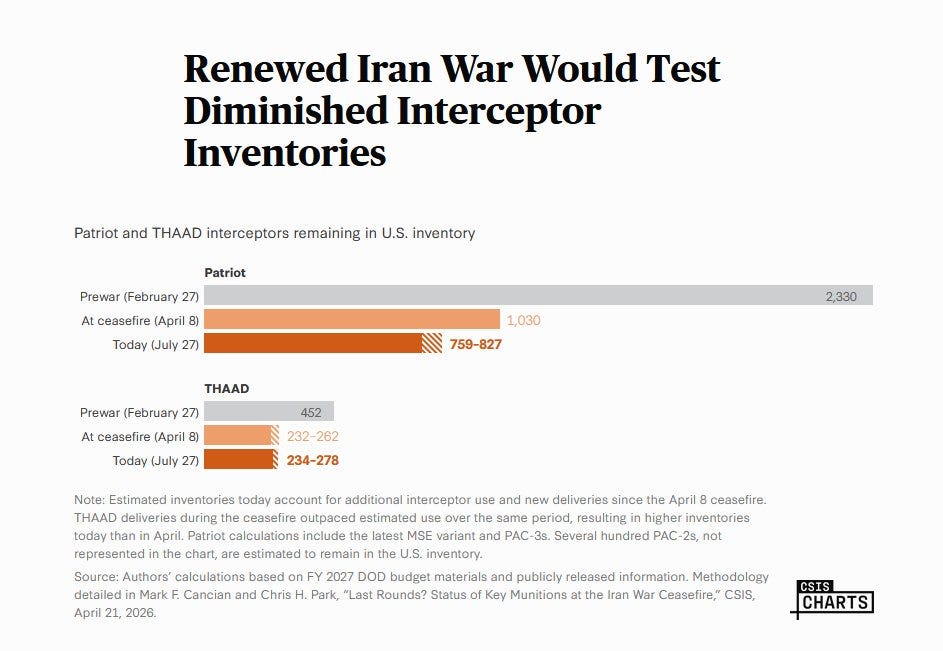
The now widely circulating CSIS estimates of remaining American Patriot ballistic missile defence (BMD) interceptor stocks refer to the PAC-3 CRI and PAC-3 MSE interceptors, which is to say that the estimate excludes PAC-2 interceptor stocks, with PAC-2 interceptors not being optimized for BMD in the manner of the aforementioned (very different) PAC-3 CRI and PAC-3 MSE interceptors.
In any event, if one were to assume 827 remaining PAC-3 CRI and PAC-3 MSE interceptors in American stocks, an average of 12 such interceptors per launcher (there is variability on the interceptors:launcher front), and eight launchers per battery/fire unit, then the United States can be estimated to possess sufficient PAC-3 CRI/PAC-3 MSE stocks for 68.9 fully-loaded launchers (launchers can also be loaded with older PAC-2 intercepors as part of a ~modular “mix and match” approach), which is to say 8.6 Patriot batteries/fire units (exclusively equipped with ready-to-launch PAC-3 CRI and PAC-3 MSE interceptors).
If one assumes a full set of available reloads—a 1:1 ratio of ready-to-launch interceptors and nearby reloads assigned to a given battery/fire unit—for each forward-deployed American Patriot battery, then the situation looks far worse for the United States and American allies in the Pacific. With only four fully equipped batteries/fire units, the United States would seemingly struggle to defend even American forces based in Japan during a war with China, let alone deploy Patriot launchers anywhere else in the Pacific, and this itself would require depriving Patriot batteries elsewhere in the world of PAC-3 CRI and PAC-3 MSE interceptors. Yes, the older PAC-2 interceptors are hardly irrelevant, but these are not as optimized against ballistic threats, not least the latest Chinese ballistic missiles.
The situation with the longer-range and higher-end THAAD BMD system is similar. To keep things brief, a “standard” THAAD battery requires 48 ready-to-fire MIM-401 Talon interceptors, and that is without considering any reloads assigned to the battery/fire unit. The CSIS estimate would suggest that the United States currently possesses enough MIM-401 interceptors for 5.79 fully-equipped THAAD batteries—the United States operates 8 THAAD batteries. Place a single THAAD battery in Guam and another in Japan, assign 96 MIM-401 interceptors to these two batteries (a full set of ready-to-fire interceptors and a full set of reloads), and there will be just 86 MIM-401 interceptors left for the six other American THAAD batteries and ~48 associated launchers, which have an upload capacity of 288 MIM-401 interceptors.