

Memos will briefly refer to a news development, media report, new or historic image/video, map, and the like. You will not receive email notifications for newly posted memos, which can be found via specific tags corresponding to specific sections/newsletters, where you will find longer posts.
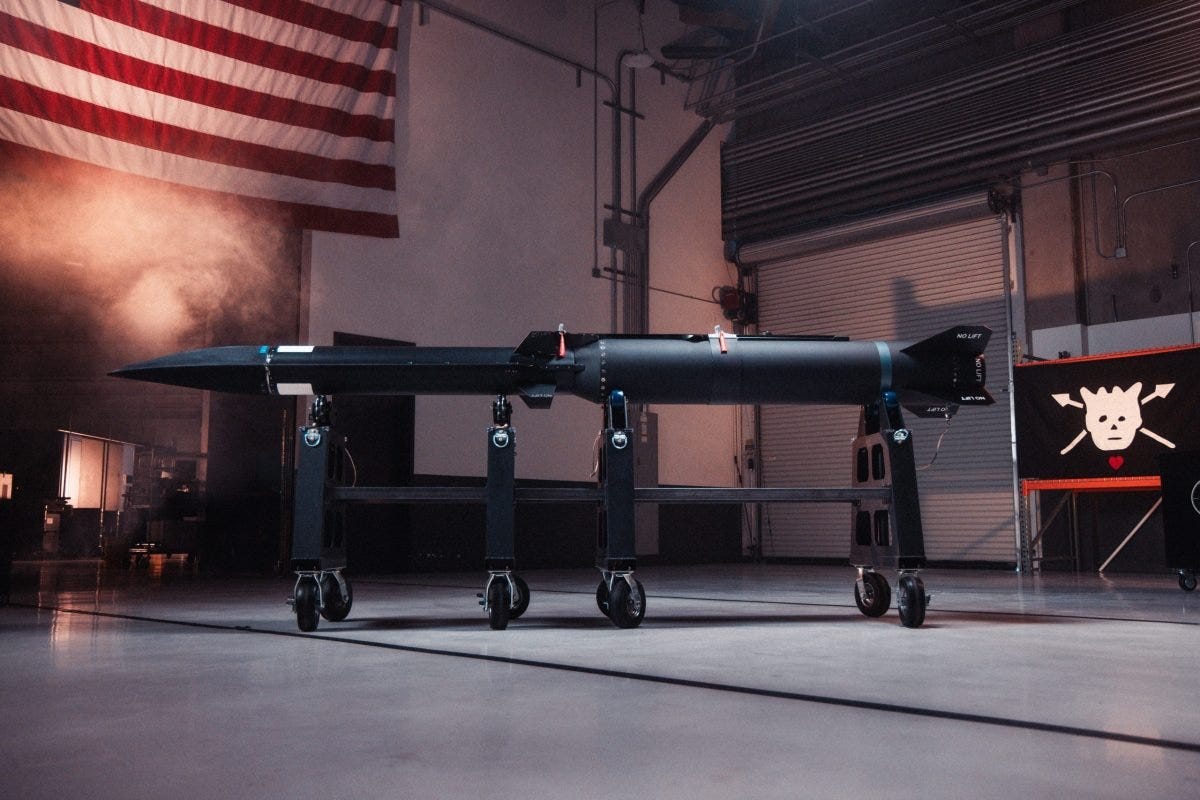
American military-industrial startup Castelion has unveiled its Blackbeard design, which is intended to offer a fairly low-cost “hypersonic” strike munition at a unit price of less than US$500,000. Here, as elsewhere, there is no magic to be found in the world of military technology. To appreciate why this is the case, and it bears emphasis that Castelion’s Blackbeard is but one example of many, it is important to first conceptualize strike munitions as having not an absolute range but a payload-range (and, where applicable, range-endurance). Simply stated and all else being equal, one can trade payload for range, or range for payload (for range for endurance and vice versa). There is, of course, more to this in practice, including, all else being equal, speed and flight profiles, but the central point should have been clearly communicated.
Having established that, it is important to briefly consider how one may go about making a strike munition such as a missile of a given performance class significantly less expensive. Some of the costs are more or less fixed or, better said, invariant. Guidance systems are a good example of this dynamic. A guidance system offering performance at level x will essentially cost the same irrespective of whether it is installed on a strike munition with a target unit cost of US$10,000, US$100,000, US$1,000,000, or US$10,000,000. Other cost factors are not strictly invariant but have limited scope for manipulation. Propulsion technology is a good example. When it comes to turbojet engines, for example, it is possible to make use of new manufacturing techniques, make maximal use of off-the-shelf components that benefit from greater economies of scale, and/or design a turbojet engine that is not overengineered for its very brief service life. It is also possible to modify the airframe. For example, a lighter airframe can not only lower the total weight of the missile, but also lower propulsion requirements, which can facilitate a reduction in production costs. This will not, of course, affect the cost associated with the guidance system, all else being equal, but nevertheless captures how cost savings can come in packages that follow an “unlock” in one area or another.
All things considered and leaving aside grossly inflated profit margins and fraud, or a dramatic increase in the scale and cadence of production, there is no practical way to make a strike munition of a given performance class significantly less expensive. The simplest way to develop a significantly less expensive strike munition is to relax the performance requirements. Suppose one is okay with receiving a cruise missile that is limited to, at best, a 100-kilogram-class warhead instead of a 500-kilogram-class warhead. Such a cruise missile will, all else being equal, be much less expensive on account of having a lighter and smaller airframe and a less powerful propulsion system, even if it is otherwise equipped with the exact same components such as the guidance system. It is not less for more, but less for less.
Granted, sometimes one does not require a 500-kilogram-class warhead for some purpose(s). Sometimes one requires scale/mass and is willing to make the trade. Sometimes one deliberately seeks an enlarged arsenal to develop some advantage over an adversary, such as by using lower-cost munitions to first deplete adversary defences and thereby create openings for other strike munitions, including the standard, more expensive cruise missile with a 500-kilogram-class warhead. At the end of the day, less is, all else being equal, typically less in the world of military hardware, even if less can be more once tactical, operational, and strategic level interactions with the adversary are taken into account.
To state the obvious, one can make a cruise missile with a 50-kilogram-class warhead at a lower cost than a cruise missile with a 100-kilogram-class warhead. An even smaller and lighter cruise missile with a 20-30-kilogram-class warhead will, all else being equal, be even cheaper still, although it bears emphasis that these costs will not scale indefinitely, certainly not if some fixed/invariant cost inputs, such as the (exact same) guidance system, do not fluctuate.
The examples provided thus far focus on turbojet-powered (subsonic) cruise missiles because the example is straightforward. Castelion’s Blackbeard is, of course, a more exotic so-called “hypersonic” weapon, but the basic points stand. How does one go about developing what is, all things considered, a very inexpensive “hypersonic” weapon? The answer is simple: relax the requirements for the destructive payload to, in all likelihood, a figure of less than 50 kilograms. For context, that is around the weight of a (necessarily thickly walled) 155 mm artillery shell, some 15%-20% of which is explosive weight. If you want a missile that can, in effect, deliver a warhead weighing about as much as a 155 mm artillery shell to a range of 700 or so kilometers and at a maximum speed of over Mach 5, then Castelion’s Blackbeard is the product for you. If, however, you want greater payload and/or greater speed and/or greater range and/or a more sophisticated guidance system, then it will, all else being equal, cost a lot more than the Blackbeard. There is no magic to be found in the world of military technology. As a general matter, if something sounds too good to be true to the uninitiated ear, that is likely to be the case, even if the—in absolute terms—“inferior product” may be very useful, of excellent value, and just what a military needs (likely to complement, not substitute for, more conventional and more expensive designs).
Any seasoned observer should have come to this basic and very important conclusion about the implications of the (non-exclusive) American turn to low(er)-cost and low-payload-range strike munitions that are, as a function of much higher unit costs, much faster than, say, a propeller-driven fixed-wing strike drone design such as the Shahed-136. The basic analytical dynamics are, however, essentially the same: if one is willing to forgo payload and/or speed, among other performance parameters, then it is possible to develop a strike munition that combines the attributes of low cost and rather extreme range. Castelion’s Blackbeard takes a similar approach with very different propulsion technology that is far more sophisticated than the four-cylinder two-stroke engine found on the Shahed-136: it is, all things considered, a very inexpensive “hypersonic” missile primarily because it is equipped with a very small and light destructive payload. Compounding matters, such a small and light destructive payload will, all else being equal, only effective against a subset of target types/classes, and even then only if the Blackbeard exhibits very good precision and accuracy, which highlights how Castelion and its ultimate intended customer, the U.S., military, cannot afford to skimp on the guidance system even as the Blackbeard deprioritizes destructive effects above almost all else in pursuit of a lower unit cost.