

Memos will briefly refer to a news development, media report, new or historic image/video, map, and the like. You will not receive email notifications for newly posted memos, which can be found via specific tags corresponding to specific sections/newsletters, where you will find longer posts.
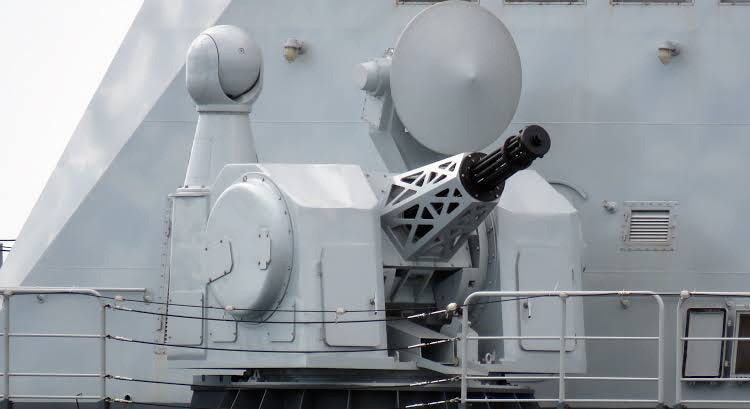
The People’s Liberation Army Navy (PLAN) encounters an expanding uncrewed surface vehicle (USV) threat, and not only from Taiwan. As things stand, most PLAN warships are poorly prepared to counter this threat on account of limited defensive armament, although this situation can change very quickly because the barriers to entry for more effective defences are quite low and China has both the requisite resources and military-industrial capabilities. Simply stated, most Chinese warships are not currently equipped with autocannons, particularly stabilized autocannons—or even smaller caliber machine guns—supported by electro-optical sights, in the manner of many American and European warships (for specific and highly contingent historical reasons). Many Chinese warships are, however, equipped with rotary cannons, including but not limited to the interrelated Chinese Type 730 and Type 1130 so-called “close in weapons systems” (CIWS), which are chambered for 30×165mm ammunition.
On paper, the Type 730 and Type 1130 amount to a formidable anti-USV capability. In practice, these are nothing of the sort. Rotary cannons consume prodigious amounts of ammunition at an eye-wateringly high rate, and thereafter take a considerable amount of time to reload. These make sense for the PLAN and other navies when used to intercept cruise missiles with armour-piercing discarding sabot (APDS) ammunition, which is typically made with either a tungsten or depleted uranium penetrator core, to severely damage an inbound cruise missile upon impact, with the extremely high rates of fire intended to compensate for the inherent inaccuracy of a single penetrator against a fast-moving inbound target, which may engage in terminal maneuvers to overcome such defences. Such highly automated radar-directed naval rotary cannons are intended to constitute the last line of defence against cruise missiles, and every navy that operates such defensive armament recognizes that the so-called CIWS can only intercept a finite number of inbound targets before running out of ammunition, and that surface-to-air missiles and soft-kill defences, namely electronic warfare systems and decoy launchers, must carry the bulk of the burden and leave the rotary cannons to deal with the leakers.
The attributes of rotary cannons in the vein of the Type 730 and Type 1130 result in a type of naval armament that can rapidly cripple, if not destroy, several USVs but afterward deprive a ship of its last line of defence against other, far more dangerous threats. Naturally, any commanding officer will employ the likes of the Type 730 and Type 1130 against USVs as and when needed, but that is not the same as saying that the likes of the Type 730 and Type 1130 are optimized against USVs.
All things considered, a far simpler and less expensive remotely controlled stabilized autocannon, including one chambered for the very same 30×165mm ammunition, supported by a slaved electro-optical sensor, is far more suitable for use against USVs, especially if it is installed on multiple parts of a ship to provide all-aspect coverage. In an ideal world, the underlying autocannon will be a dual-feed design capable of employing both high explosive incendiary (HEI) ammunition against USVs and high explosive airburst (HEAB) ammunition against the likes of propeller-driven strike drones (or, alternatively, one of the aforementioned types of ammunition alongside armour-piercing ammunition against USVs). It bears emphasis that the Type 730 and Type 1130 are single-feed designs that can only be loaded with a single type of ammunition. A stream of 30 mm APDS projects will likely obliterate a USV upon impact, but the likes of the Type 730 and Type 1130 are also suboptimal against propeller-driven strike drones and similar, especially if and when these are employed in large numbers, and are, all things considered, optimized for use against a single type of target at sea: (fairly) high-speed inbound cruise missiles, especially those of the supersonic variety against which the engagement parameters of any gun-type direct-fire armament situated just above sea level are highly constrained.