
Geography Amplifies Threat Ansarallah's Iranian-Supplied Strike Capabilities Pose To Saudi Arabia
🇮🇷 🇸🇦 🇾🇪 | Memo

Memos will briefly refer to a news development, media report, new or historic image/video, map, and the like. You will not receive email notifications for newly posted memos, which can be found via specific tags corresponding to specific sections/newsletters, where you will find longer posts.
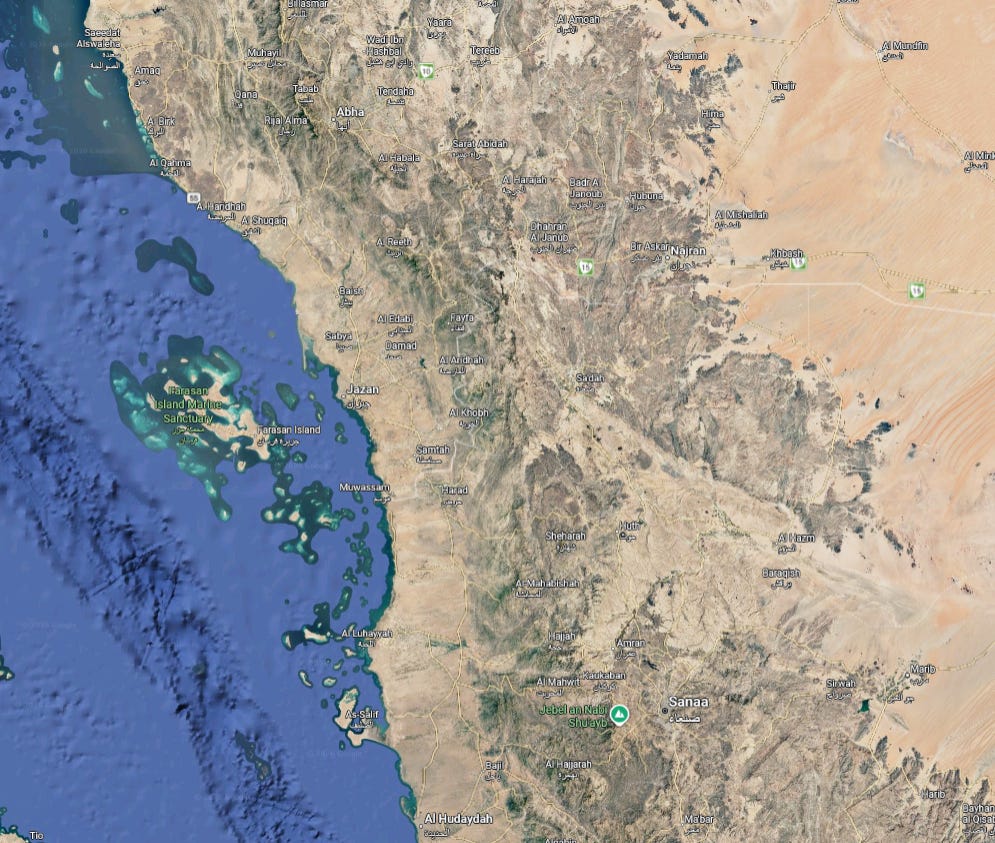
The de facto forward deployment of Iranian strike munitions in the areas of Yemen controlled by Ansarallah has long fundamentally reshaped military dynamics in the Middle East. While Yemen borders Saudi Arabia, most lucrative targets are quite far from Yemen. Saudi Arabia’s extreme southwest is, however, very close to Ansarallah-controlled territory, and this geographical proximity amplifies the threat that Ansarallah’s Iranian-supplied strike capabilities pose to Saudi Arabia.
The distance between Sa’dah, Ansarallah’s stronghold, and Jizan, a coastal Saudi city with a population of around 200,000, is approximately 125 kilometers. The inland Saudi city of Najran, which has a population of around 400,000, is approximately 85 kilometers from Sa’dah. The combined population of the inland Saudi cities of Abha and Khamis Mushait, which are locted is approximately 190 kilometers from Sa’dah, is around 1,000,000. These locations are, of course, much closer to what amounts to the frontier between Ansarallah and Saudi Arabia (Sa’dah is further inland), and a significant portion of Saudi Arabia’s population resides within just several hundred kilometers of Ansarallah-controlled territory. For context, the coastal city of Jeddah is around 650 kilometers from Ansarallah-controlled territory, while Riyadh is around 850 kilometers from Ansarallah-controlled territory.
The barriers to entry are much lower when it comes to attacking targets situated within 100-200 kilometers with strike drones, cruise missiles, and even smaller short-range ballistic missiles. The amplified effects of geography in this area amount to a major source of advantage for Ansarallah and, as such, for Iran, vis-a-vis Saudi Arabia, not least in a context in which the American and Israeli war against Iran and the regional externalities thereof have reportedly resulted in the severe depletion of Gulf Arab, as well as American, ballistic missile defence interceptor and surface-to-air missile stocks. A major source of Iran’s structural military advantages vis-a-vis the Gulf Arab states is rooted in how the Persian Gulf is no more than 200-300 kilometers wide in most areas. In southwestern Saudi Arabia, some 4,000,000 Saudis reside within a similar—if not significantly less—distance of Iran’s de facto forward-deployed strike munitions in northern Yemen.
🇮🇷