

Commentary-themed posts are intended to broach or highlight a specific issue, not limited to recent and ongoing events. These posts will typically be much shorter and less detailed than analysis-themed posts.
Note: The following text was originally posted on my 𝕏/Twitter account. The original post may be expanded upon and edited for grammar and style in this here post. Link
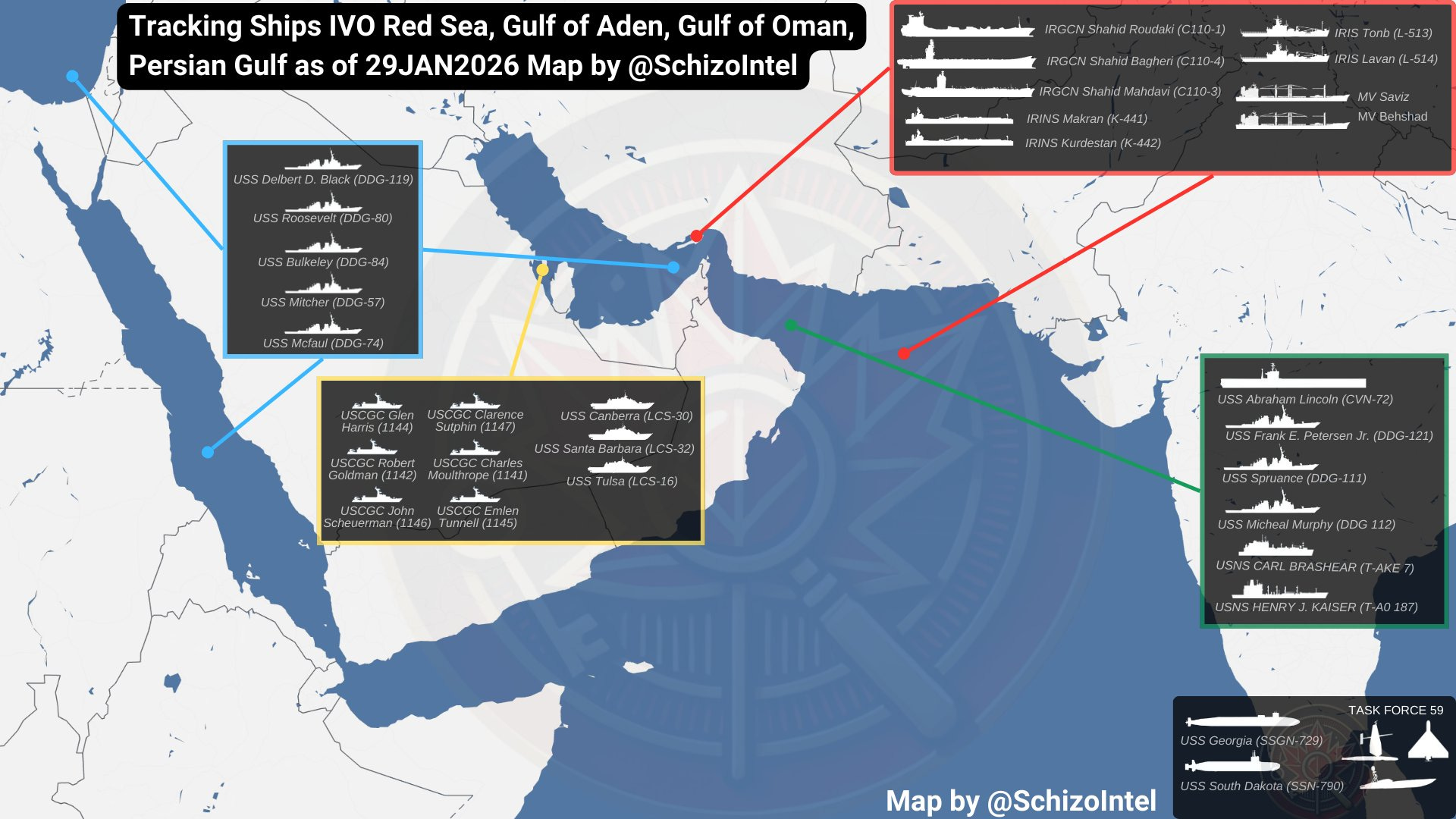
One of the more curious dynamics currently at play concerns how the interplay of geography and Iranian maritime strike capabilities has divided the American naval presence in the Middle East into three separate components that are risky to concentrate into a single more capable force. The United States Navy now finds itself in a situation that is broadly similar to the everyday reality of the Russian Navy: subunits that cannot readily concentrate as a result of the interplay of geography—and, in the American case, Iranian maritime strike capabilities deployed in Iran itself as well as in Yemen through the services of Ansarallah.
There are three Independence-class littoral combat ships and two Arleigh Burke-class destroyers that are, in effect, "trapped" inside the confined, narrow, and shallow waters of the Persian Gulf. The Strait of Hormuz is a bona fide maritime chokepoint—it is the only way in and out, and Iran is very well positioned to threaten any ship that attempts to force a transit.
All things considered, and notwithstanding the formidable air and ballistic missile defence capabilities of the two Arleigh Burke-class destroyers in the Persian Gulf, these warships are best extricated from that confined body of water and are ideally sent to the Arabian Sea so that they can operate alongside the aircraft carrier USS Abraham Lincoln and the three Arleigh Burke-class destroyers that serve as that aircraft carrier’s escorts. This will require these two American destroyers currently in the Persian Gulf to run the proverbial Iranian gauntlet when undertaking an outbound transit of the Strait of Hormuz.
The Arleigh Burke-class destroyer USS Delbert D. Black recently made an unpublicized transit of the Suez Canal from the Mediterranean into the Red Sea, with its most recent port of call being the southern Israeli port of Eilat. This destroyer is likely to stay put in the northern half of the Red Sea to intercept ballistic missiles launched against Israel from Iran and/or ballistic missiles launched against Israel by Ansarallah in Yemen, alongside the two Arleigh Burke-class destroyers that remain in the eastern Mediterranean to do the same. Even so, the U.S. Navy encounters a parallel risk should it dispatch the USS Delbert D. Black to transit into the Arabian Sea via the Bab al-Mandeb, which will entail running the gauntlet established by Ansarallah's primarily Iranian-supplied maritime strike capabilities.
If the United States is going to send additional warships to join the aircraft carrier USS Abraham Lincoln and its three escorts in the Arabian Sea, it will have to decide whether American warships will force the Bab al-Mandeb and run Ansarallah’s gauntlet. The aircraft carrier USS George Bush—which is currently undertaking training activities off the American east coast—is one of the carriers that may be sent to reinforce the USS Abraham Lincoln in the Arabian Sea. Another candidate is the USS Gerald Ford, which continues to operate near Venezuela. Transiting to the Central Command (CENTCOM) area of responsibility via the Mediterranean in the shortest possible time will necessitate a transit of the Suez Canal and the Bab al-Mandeb. The alternative is for the aforementioned aircraft carriers to take a very lengthy detour around the southern tip of Africa so as to avoid running Ansarallah's gauntlet, not least in the event of open war with Iran and its non-state allies, including Ansarallah in Yemen. Alternatively, the United States can dispatch an aircraft carrier from the American West Coast, although that entails a very long journey across the Pacific.
While the United States has many options, and the American naval presence near Iran remains formidable, the de facto forward deployment of Iranian terrestrial and maritime strike munitions in Yemen through the services of Ansarallah has fundamentally transformed military dynamics in the region in ways that the current crisis is putting on public display.