
Large American Orders For Armed Drones Highlight Scope For "The Strong" To Get Even Stronger In Age Of Inexpensive Guided Munitions
🇺🇸

For all the talk of a “military revolution” in which low-cost guided munitions, including the likes of armed multirotor drones built using commercial off the shelf (COTS) components and propeller-driven fixed-wing loitering strike drones, allows “the weak” to become stronger, large American orders for such munitions increasingly highlight the scope for the very same technological dynamics to make “the strong” even stronger. The American army recently announced a US$982 million contract for Israeli-designed HERO-120 propeller-driven fixed-wing loitering strike drones. With this order and many other efforts to develop and deploy armed drones of various types, including so-called “first-person video” (“FPV”) armed multirotor drones, the American military is not only “catching up” with other countries but bringing its immense and, with the sole exception of China, bringing its incomparable resources to bear.
Few militaries can afford to spend thousands, even tens of thousands, of additional (U.S.) dollars to equip their single-use armed drones with higher-end electro-optical sensors, infrared-band sensors, and, among other things, sophisticated warheads with advanced fusing options. The American military is very well positioned to do so, with the result that, for example, an American army unit equipped with armed “FPV” mulitorotor drones may not need to use 5-10 such uncrewed aircraft-turned-munitions to destroy a tank—as is often the case with Russian and Ukrainian armed mulitorotor drone operators—but just one or two. Even if a higher-end American armed drone costs an order of magnitude more than a comparable lower-end design that makes extensive use of inexpensive COTS components, the United States can exchange money for time and faster effects, which will allow American drone operators to focus on other targets and, as such, enable the American military to attrit enemy forces at a faster rate than enemy fores can do in return.
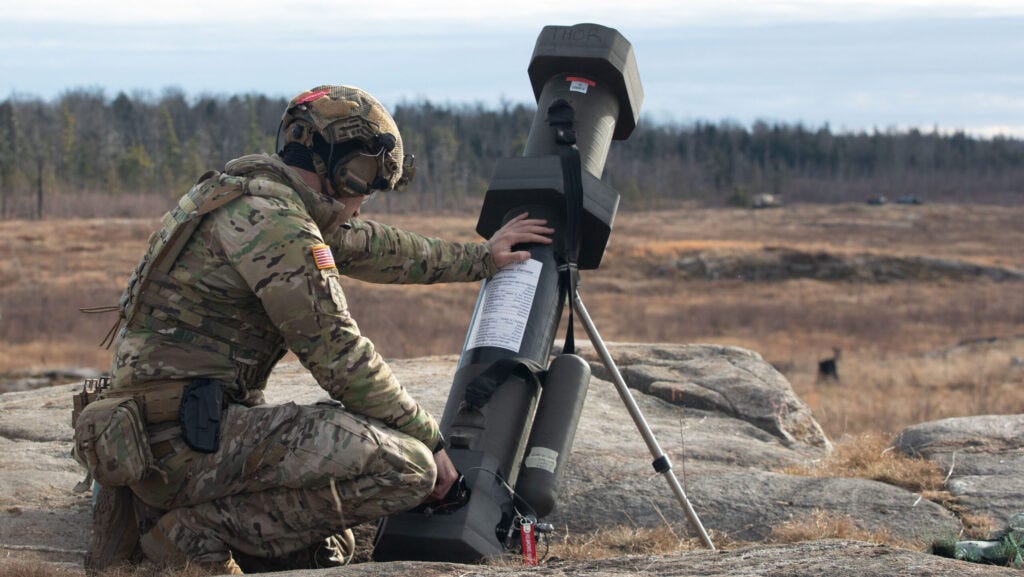
The procurement of the HERO-120 loitering strike drone exemplifies this dynamic. The HERO-120 can be used to deliver a 4.5-kilogram shaped charge warhead of the type typically installed on high-end anti-tank missiles to attack armoured combat vehicles and other targets over a distance of 40-60 kilometers. The American army already has extensive anti-armour capabilities, including the very high-end—and very expensive—FGM-148 Javelin anti-tank missile. The FGM-148 is, however, a line-of-sight anti-tank missile with a maximum range of up to five kilometers. While the FGM-148 remains an excellent tool for light infantry to knock out, if not destroy, most armoured vehicles in existence with a single shot, the HERO-120 will allow American brigades and even battalions to independently destroy the critical pieces of enemy equipment used by substantially larger enemy formations faster than enemy formations can practically attrit American forces using lower-cost, COTS reliant armed drones of various types. It bears emphasis that even without the assistance of the formidable air-to-ground capabilities of the American air force fixed-wing combat aircraft and army attack helicopters, American ground combat units can also draw upon a long list of other means of fire support, including guided artillery rockets as well as artillery and mortars that can be cued to targets detected by the higher-end and more expensive electro-optical and infrared sensors installed on the higher-end and more expensive drones of various types that the American military is procuring.
Any military—or non-state armed group—that gets into a close-range fight with American ground forces in the coming years will be exposed to an unprecedented combination of firepower and intelligence, surveillance, and reconnaissance capabilities. As the best-resourced military in the world, the American military can afford to pay a steep premium for higher-end loitering strike drones and armed multirotor drones that most other militaries cannot even imagine acquiring, let alone expending, in large numbers. It bears emphasis that the United States has the resources required to simultaneously deploy both higher-end armed drones and lower-end drones in numbers that few adversary states, let alone non-state, adversaries, can compete.
While technological change does, in a not unimportant sense, help “the weak” to become stronger, it is important to recognize that it also allows “the strong” to become even stronger. In the real world, the key issue is the differential effects of technological change, which is to say relative, not absolute, gains in combat capabilities. The best-resourced militaries can, all things considered, deploy greater numbers of essentially any type of military equipment than their less well-resourced counterparts. Adversaries of the United States encounter an additional challenge in that while countermeasures to various types of armed drones exist, the most effective countermeasures are quite expensive, not least when these must be deployed in the many hundreds, if not the many thousands of units. The best-resourced militaries can, all things considered, deploy both large numbers of armed drones of various types, including higher-end designs, and countermeasures thereto.