

Scratchpad-themed posts briefly introduce ideas and notes that may be followed by a memo or longer analysis at a future date. Posts filed under the scratchpad section/newsletter are only accessible to subscribers, whether free or paid. For the purposes of navigating this site, scratchpad-themed posts are organized under the region-themed topic-themed subsections under "Memos." You will not receive email notifications for newly posted scratchpad-themed posts.
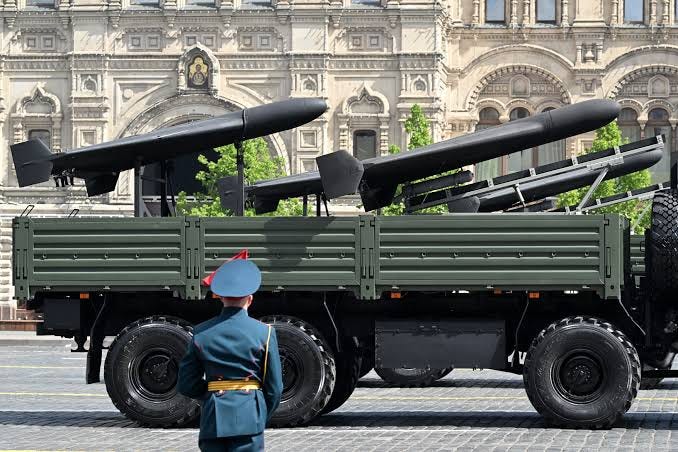
Russian state media reports that the manufacturer of a second, distinctly Russian, derivative of the Iranian-designed Shahed-136, the Garpiya-A1, is offering the design to potential export customers. The Garpiya-A1 is being offered by Almaz-Antey, the parent company of the IEMZ Kupol factory at Izhevsk, Udmurtia, which is home to a separate production line from the better-known facility at Alabuga, Tatarstan. The entire Garpiya-A1 saga remains curious given how this amounts to a nominally Russian reverse-engineered Shahed-136 that makes extensive use of components sourced from China in a context in which the Russian state has, by all accounts, overseen the dramatic expansion of the Shahed-136/Geran-2 at Alabuga but not that of the Garpiya-A1 at Izhevsk. More generally, there is little indication that IEMZ Kupol is actively working on other designs, including some other Chinese-origin designs that media outlets have previously reported on. Meanwhile, the Alabuga facility is not only behind the Geran-2, but also its initial and rather crude turbojet-powered version, the Geran-3, the succeeding better-optimized and essentially clean-sheet turbojet-powered Geran-4, the altogether different Geran-5 cruise missile, as well as the truly mass-produced Gerbera decoy drone. IEMZ Kupol, in contrast, appears to be a relative backwater as far as both research and development activity and production are concerned.
Perhaps the Russian state sought to hedge its bets on Alabuga and wean itself from its initial heavy reliance on Iran in this increasingly important area of military technology. In any event, IEMZ Kupol’s production differentiation is modest, and Moscow likely encounters incentives to harmonize production capacity at Alabuga, not least as measure-countermeasure dynamics are incentivizing greater production of the turbojet-powered Geran-4 and Geran-5 over the propeller-driven Geran-2 and, as such, the Garpiya-A1. Exports could provide a reason for IMEZ Kupol and its parent company, Almaz-Antey, to sustain production of the Garpiya-A1 at a time when it has been superseded by Alabuga’s Geran-2 and other, increasingly unrelated, designs, in more ways than one. It bears emphasis that Almaz-Antey will, via Rosoboronexport, be entering an increasingly crowded market for propeller-driven fixed-wing strike drones in the vein of the Shahed-136. Such is the nature of things in a market segment that has always been characterized by low barriers to entry.