

Scratchpad-themed posts briefly introduce ideas and notes that may be followed by a memo or longer analysis at a future date. Posts filed under the scratchpad section/newsletter are only accessible to subscribers, whether free or paid. For the purposes of navigating this site, scratchpad-themed posts are organized under the region-themed topic-themed subsections under "Memos." You will not receive email notifications for newly posted scratchpad-themed posts.
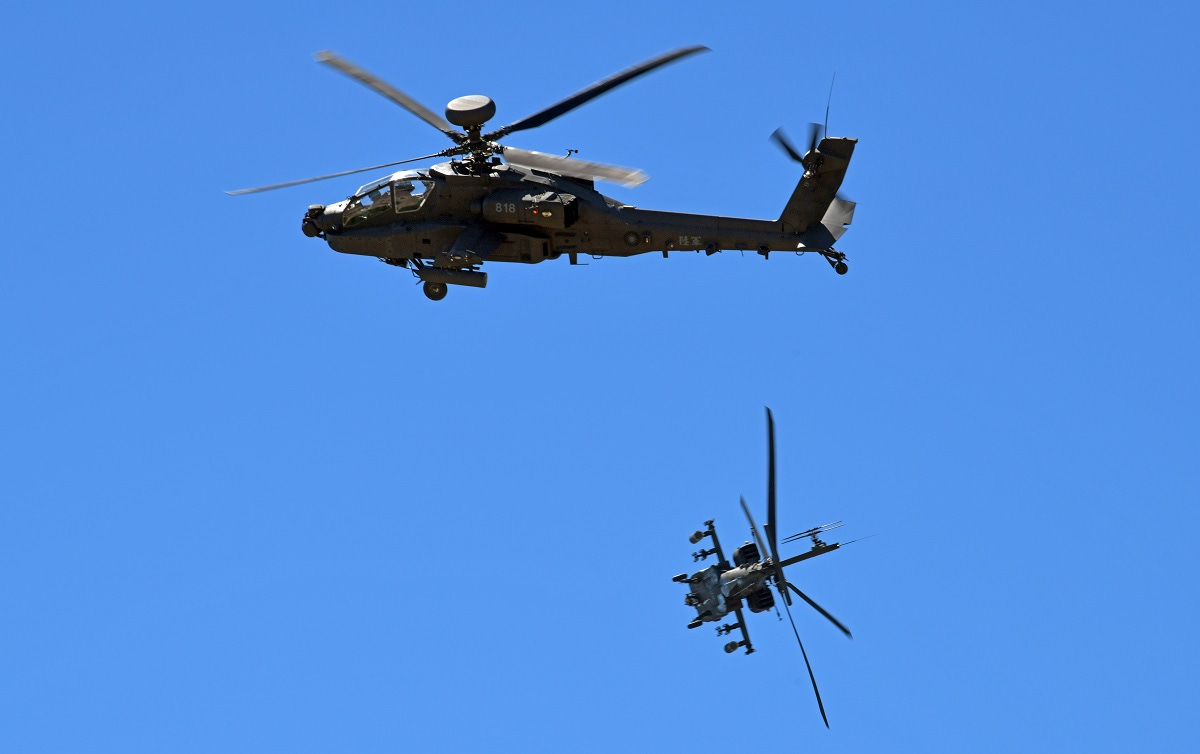
Taiwan’s large fleet of attack helicopters, which includes American-built AH-64E Apache, is often pitched as an aerial quick reaction force that can respond to amphibious, heliborne air assaults, and parachute-dropped airborne landings by the People’s Liberation Army (PLA). In principle, Taiwan can effectively employ its attack helicopters in this manner, although there are a lot of caveats, and attack helicopters are likely to be far less effective in certain conflict scenarios. All things considered, Taiwan’s attack helicopter fleet faces two major interrelated challenges: the threats to low-flying attack helicopters are increasing, and for this and other reasons, attack helicopters require longer-range armament, which Taiwan’s attack helicopters are not equipped with.
While it is premature and overly dramatic to declare “attack helicopters are dead,” the reality is that attack helicopters face mounting threats around stationary frontlines, which is to say in situations in which there is little to no element of surprise. Taiwan’s attack helicopters must fly at low altitudes with the aim of blending into the complex topography of the Earth to remain survivable in the face of ongoing advances in Chinese air combat capabilities. Doing so, however, will generally mean operating at a slower speed, which exposes Taiwan’s attack helicopter to a very different new generation of threats, including multirotor drones that treat slowly moving and hovering helicopters as exceptionally lucrative targets of opportunity. The initial crop of multirotor drones used in the Russia-Ukraine War lacked the kinematic performance required to target attack helicopters other than in chance encounters. More recent electrically-powered interceptor drones, however, can “outrun” an attack helicopter and therefore pose a far more credible threat. Chinese industry is a world leader in most of the components going into such designs, and such capabilities will likely be available to the PLA. When viewed alongside the long-standing threat posed by Chinese shoulder-launched manportable air defence systems (MANPADS), gone are the days in which lightly equipped Chinese infantry landing on the island of Taiwan would be defenceless against attack helicopters such as the AH-64.
In principle, such threats can be blunted by employing longer-range munitions from attack helicopters. This comes with a series of complications, not least cost and payload restrictions, that at some level beg the question of whether attack helicopters are (universally) the most suitable and/or most cost-effective means of delivering the desired effects, but nevertheless constitute a path forward. As things stand, Taiwan’s attack helicopters are, at best, equipped with AGM-114 Hellfire missiles which have a modest range relative to current and prospective threats, especially when launched from a low altitude and at a low speed. While there are other, longer-range missiles on the market, the situation in Taiwan appears unlikely to change anytime soon, and Taiwan’s attack helicopter force currently appears far more capable on paper than it is likely to be in practice over the near term.