

Memos will briefly refer to a news development, media report, new or historic image/video, map, and the like. You will not receive email notifications for newly posted memos, which can be found via specific tags corresponding to specific sections/newsletters, where you will find longer posts.


Russia’s ongoing use of the ordinarily ship-launched supersonic 3M22 Zircon rocket-powered quasi-ballistic missiles (the image on the left) against terrestrial targets in a ground-launched capacity using launchers associated with the Bastion-P coastal defence system (the image on the right) is indicative of the evolving division of labour when it comes to Russia’s long-range conventional strike capabilities amid the Russia-Ukraine War and in a post-INF Treaty world.
As things stand, the Russian Air Force employs air-launched cruise missiles of various types as well as the 9-S-7760 (“Kh-47 Kinzhal”) air-launched ballistic missiles from bomber aircraft and modified MiG-31K aircraft, respectively, alongside a series of shorter-range cruise missiles employed by fighter-type combat aircraft. The Russian Army operates 9M723 Iskander-M ballistic missiles, 9M728 Iskander-K subsonic ground-launched cruise missiles, extended-range 9M729 subsonic cruise missiles, as well as propeller-driven long-range fixed-wing strike drones in the vein of the Shahed-136/Geran-2, as well as turbojet-powered strike munitions including the Geran-3, Geran-4, Geran-5, and Banderol. The Strategic Rocket Forces, meanwhile, has transitioned from exclusively operating nuclear-armed ballistic missiles of so-called intercontinental range to also operating the Oreshnik, which has been used against Ukraine with a conventional payload. Not to be excluded, the Russian Navy is not only launching subsonic 3M14 Kalibr long-range cruise missiles from its ships and submarines alongside 3M22 Zircon missiles, but is also sporadically employing its land-based anti-ship cruise missiles, including the 3M55 (P-800 Oniks) associated with the Bastion-P system to attack terrestrial targets in Ukraine.
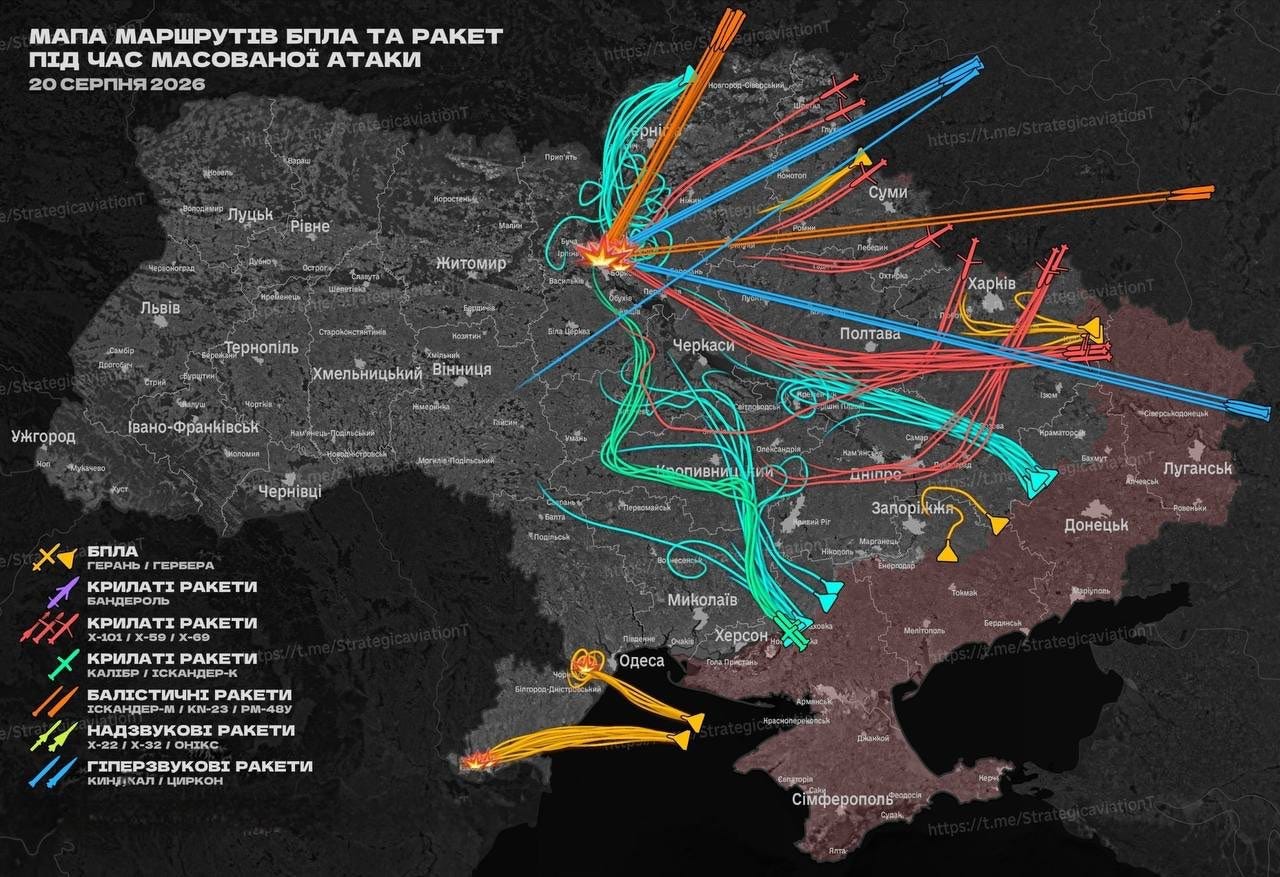
The use of 3M22 Zircon missiles in a ground-launched capacity using launchers associated with the Bastion-P coastal defence system is in line with the wartime trends in the Russian military. This dynamic reflects, in no small part, the pressures faced by the Russian Black Sea Fleet and the attrition it has faced, which has reduced the number of vertical launch system (VLS) cells available for 3M14 Kalibr and 3M22 Zircon missiles to be used against Ukraine. This is, however, also a reflection of a broader and more important dynamic: the demise of the ill-conceived and much-hyped “Kalibrization” of the Russian surface fleet—as well as Russia’s diesel-electric submarine fleet—which inherently entailed corvettes and frigates briefly heading out to sea to launch a maximum of eight to sixteen—typically just eight—long-range land-attack munitions before having to return to port so as to rearm.
In the context of confined waters such as the Black Sea and the Baltic Sea, this approach never made much sense, with Russia being, all things considered, better off simply launching such land-attack munitions from ground-based launchers and reserving the VLS cells on warships for other purposes. This was not, of course, possible under the strictures of the now-defunct INF Treaty, but here, as elsewhere, Russia has been slow to adapt to a post-INF world even as its actions brought about the demise of the treaty.
Reports of Russia’s employment of anti-ship cruise missiles with a secondary land-attack mode against terrestrial targets emerged early in the Russia-Ukraine War and were likely motivated by the severe depletion of Russia’s strike munition arsenal in 2022. The employment of the 3M22 Zircon in a ground-launched capacity using launchers associated with the Bastion-P coastal defence system, which have been redeployed inland far from the Black Sea coast for this purpose, is likely indicative a different dynamic, one that may eventually come to result in either the 3M22 Zircon being adopted by some other part of the Russian military for use as a ground-based land-attack strike munition, or, more speculatively but also more significantly, with the Russian Navy deploying a ground-based VLS system, perhaps something in the vein of the American Typhon system derived from the Mark 41 VLS, so as to draw upon the Russian Navy’s stocks of 3M14 and 3M22 missiles if and when surface ships and submarines cannot launch said strike munitions, or launch said strike munitions at the required cadence and salvo size, for whatever reason. As things stand, the launchers from the Bastion-P coastal defence system associated with the practice of launching 3M22 Zircon missiles from inland positions are not known to be capable of launching 3M14 Kalibr cruise missiles, but this development may nevertheless be a sign of things to come.