

Memos will briefly refer to a news development, media report, new or historic image/video, map, and the like. You will not receive email notifications for newly posted memos, which can be found via specific tags corresponding to specific sections/newsletters, where you will find longer posts.
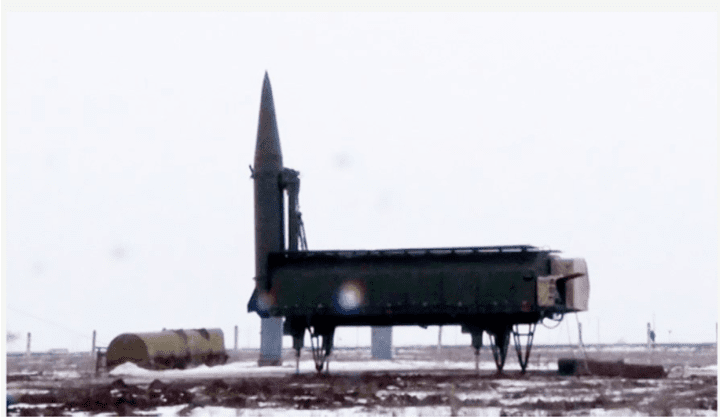
Reports of an extended-range variant of Russia’s 9M723 Iskander-M ballistic missile first became public in the summer of 2024. With a reported maximum range of 1000 kilometers, this extended-range “Iskander-1000,” which has more recently been referred to as the 9M723-2, has the potential to significantly enhance Russia’s long-range conventional strike capabilities in more ways than one. Beyond simply expanding the reach of the Russian Army’s conventionally armed ballistic missiles to a maximum range of 1000 kilometers, such a ballistic missile would also enhance Russia’s ability to undertake multi-axis attacks against distant targets. In the context of the Russia-Ukraine War, for example, a 1000-kilometer-range ballistic missile can not only be used to attack most of Ukrainian territory, including the western city of Lviv, when launched from Russia proper, but can also be used to target Ukraine from launches in the Russian exclave of Kaliningrad. Russia can, of course, undertake such launches simultaneously, thereby subjecting Ukrainian ballistic missile defence systems to simultaneous multi-axis attacks that can be very difficult to defend against.
An extended-range 9M723 variant, and any longer-range Russian ground-launched ballistic missile more generally, has significant implications for NATO and Europe. A 1000-kilometer-range ballistic missile can, for example, be used to target NATO’s early warning radars as well as the likes of the Aegis Ashore ballistic missile defence facility in Deveselu, Romania. Russia can, for example, also employ such ballistic missiles in multi-axis attacks against targets across much of Scandinavia. As a result, Russia may finally come to possess a much-needed “door-breaker”-type capability that can create openings for its other strike systems, all at a time when stocks of ballistic missile defence interceptors are critically low following expenditures in the American and Israeli war against Iran.
All things considered, Russia has been remarkably slow to shift its fielded military capabilities in response to the end of the INF Treaty. While the extended-range 9M729 ground-launched subsonic land-attack cruise missile helped bring about a transition to a post-INF Treaty era, Russia does not appear to have rushed to fill critical capability gaps in the realm of conventionally armed ballistic missiles with a maximum range greater than the 500 kilometers associated with the baseline 9M723. A 1000-kilometer-range version of the 9M723 Iskander-M will help close a longstanding capability gap that the Soviet Army-turned-Russian Army has experienced since 1988, but will still leave much unaddressed. The German-Polish border is some 1000 kilometers from the western borders of Russia proper (i.e., excluding Kaliningrad). The Rhine is some 1500-1600 kilometers away, and London and Paris, for example, are some 2000 kilometers away.
Although the conventionally armed version(s) of the Oreshnik can be employed against such targets, there exists a possibility that Russia will eventually follow the lead of China and Iran in deploying conventionally armed ballistic missiles with a maximum range of 1000-2000 kilometers. Iran has demonstrated what a country such as Russia can obtain from such missiles as well as the limitations thereof, with the caveat that Russian industry is in important respects better-positioned to develop a more accurate ballistic missile design. Furthermore, Russia’s military-geographical position vis-a-vis NATO provides it with some structural advantages that Iran does not enjoy vis-a-vis Israel, but does vis-a-vis the Gulf Arab states, even accounting for variance in distances. As indicated earlier, the implications in terms of possible launch geometries are, in many respects, greater than the implications in terms of a simple extension of maximum range.