

Commentary-themed posts are intended to broach or highlight a specific issue, not limited to recent and ongoing events. These posts will typically be much shorter and less detailed than analysis-themed posts.
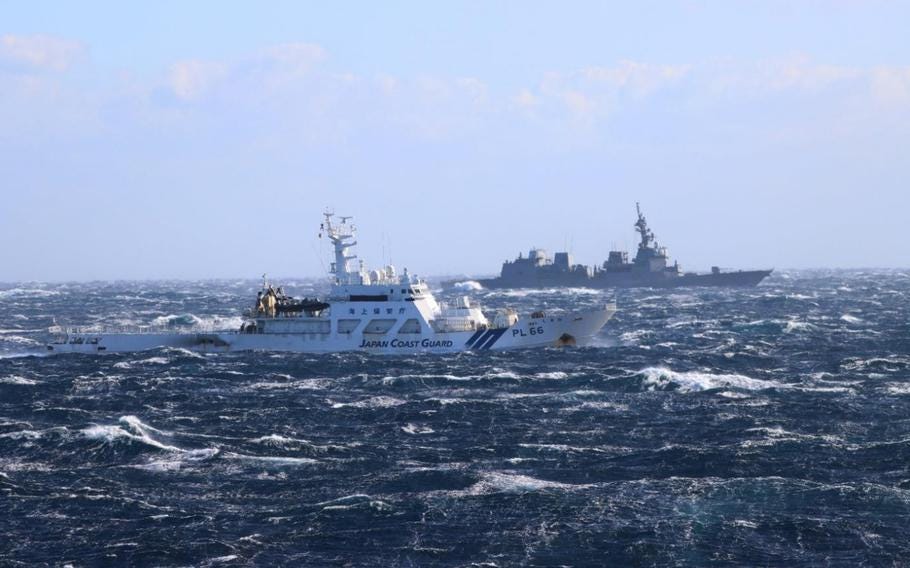
This post is intended to broach a specific question: what will the Japan Coast Guard (JCG) do in the event of a major conflict in the Indo-Pacific that involves China, Taiwan, Japan, and, presumably, the United States? Tokyo cannot afford to overlook the potential wartime role(s) that an organization home to more than 14,000 trained, able-bodied personnel—including many mariners and aviators—can play during a hypothetical major conflict in which Japan will likely have to muster all of its sources of national strength.


The JCG, which was established as the Maritime Safety Agency in 1948, emerged from the proverbial ashes of the Imperial Japan Navy. Coast guard-type organizations exist in a variety of flavours. The JCG is formally a civilian coast guard organization subordinate to Japan’s Ministry of Land, Infrastructure, Transport and Tourism. In this important respect, the JCG differs from the explicitly paramilitary U.S. Coast Guard (USCG)—which is subordinate to the Department of Homeland Security in peacetime and the Department of Defense in times of war—and the explicitly paramilitary China Coast Guard (CCG)—an organization that is part of the paramilitary People’s Armed Police (PAP) and reports to China’s Central Military Commission (CMC) in the same manner as the People’s Liberation Army (PLA).
While formally a civilian organization that is neither administratively subordinate to Japan’s Ministry of Defense nor under the operational control of the Japan Self-Defense Forces, the JCG nevertheless operates a non-trivial number of (very modestly) armed patrol ships—a development that notably long predates more recent tensions with China over Japanese-controlled features in the East China Sea that China now actively disputes. In the event of a major war in the Indo-Pacific, even the largest and most—relative to other JCG vessels—“heavily-armed” JCG patrol ships are unlikely to directly participate in naval operations in the Philippine Sea and around the Japan’s Ryukyu Island Chain, but can nevertheless fulfill roles of non-zero importance in terms of bolstering maritime defences and, no less importantly, and air defences around the Japanese archipelago. JCG vessels are likely to also help facilitate what will likely amount to an all-of-government effort—supported by the privately-owned shipping and aviation sectors—to evacuate civilians from Japan’s Sakishima Islands in the event of a major cross-Taiwan Strait crisis. The JCG may, in time of war, also be stripped of some of its more militarily useful assets, as well as some of its trained personnel, to bolster the Japan Air Self-Defense Force (JASDF) and the Japan Maritime Self-Defense Force (JMSDF).


It is productive take a moment to highlight some of the more militarily useful JCG assets. These include:
19 larger JCG patrol vessels that can embark at least one helicopter.
10 medium-to-large surface search radar-equipped maritime patrol aircraft.
3 MQ-9B SeaGuardian surface search radar-equipped large uncrewed fixed-wing maritime patrol aircraft, which are a variant of the American MQ-9 Reaper.
~60 helicopters of various types, most of which exist to provide maritime search and rescue (SAR) services to civilians that will still be required in time of war.
The JCG’s land-based coastal (surface search) radar network.
In the event of war, the aforementioned JCG assets and associated personnel can be used to bolster JSDF units tasked with:
Patrolling Japan’s coastline so as to provide early warning of approaching (potentially armed) uncrewed surface vessels (USVs) and (potentially armed) fixed-wing strike drones, and potentially intercept such threats either independently or in concert with the JASDF and/or JMSDF, as well as the Japan Ground Self-Defense Force (JGSDF), which plays an important role in coastal defence.
Support JMSDF convoying measures to secure merchant ships operating from one Japanese port to another, including vessels used to transport critically important fuels and chemicals from import hubs to industrial facilities across the Japanese archipelago.
Support JMSDF and JASDF military search and rescue efforts, which will doubtless take place in coordination with American search and rescue efforts.
Being home to a pool of Japanese persons trained in the operation of small arms and, in some cases, ship-mounted autocannons, the JCG may also be called upon to help bolster wartime Japan’s ground-based short-range air defences to intercept the likes of a Chinese analogue to the Iranian-designed Shahed-136 single-use propeller-driven fixed wing strike drone design that Russia uses against Ukraine under the designation Geran-2.
It bears emphasis that Japanese decision-makers will need to decide—if they have not already done so—when they will pull back JCG vessels and aircraft from “frontline sectors” in the event of a major crisis with China. This includes operations around the Ryukyu Island Chain, given how JCG vessels and aircraft that continue to patrol in this sector are likely to be treated as militarily relevant targets by the PLA, not least when we are discussing JCG vessels—some of which are armed—and aircraft that are equipped with radars that can detect Chinese warships and, in some cases, Chinese aircraft. JCG vessels and aircraft are not equipped with defensive countermeasures and/or defensive armament to have any chance of surviving PLA attacks, a dynamic in which the JCG fleet is notably unlike a specific subset of both the USCG and CCG fleets.
Given the above, JCG operations during a crisis will likely be closely coordinated with the JASDF and JMSDF, and Tokyo may well decide to pull back JCG vessels and aircraft from the Ryukyu Island Chain to the Japanese archipelago as the shadow of war approaches. There is a caveat to be made with respect to an all-of-government effort to evacuate civilians from the Sakishima Islands, but JCG vessels and aircraft have no business being anywhere near the Ryukyu Islands in the event of war with China and are, more to the point, far more useful to Japan’s war effort when located elsewhere.