

Memos will briefly refer to a news development, media report, new or historic image/video, map, and the like. You will not receive email notifications for newly posted memos, which can be found via specific tags corresponding to specific sections/newsletters, where you will find longer posts.
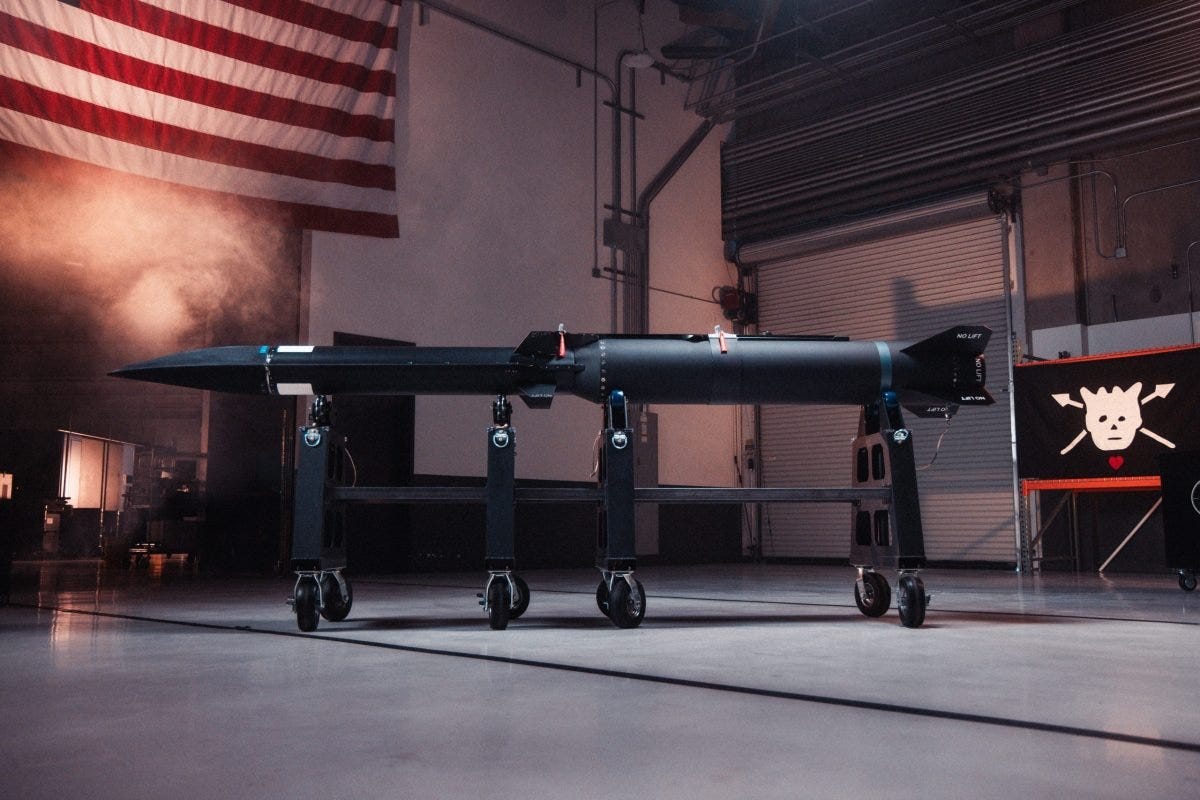
The American (non-exclusive) pursuit of a series of new low(er)-cost and, importantly, lower payload-range strike munitions, whether Castelion’s Blackbeard “hypersonic missile” or a series of new subsonic cruise missiles, has a series of implications for the China-United States military balance. Many others have written on the (assumed) implications of the likes of the Blackbeard missile for China from an American perspective, but have given inadequate attention to the other side of the ledger: what happens if and when China emulates this American approach—which is ultimately the more lavish and technologically sophisticated American take on a conceptual approach first adopted by Iran and later expanded upon by both Russia and Ukraine—and does more or less the same in kind?

As explained in the above post with respect to Blackbeard, there is no magic to be found in the world of military technology. All such “low-cost” strike munitions reflect major design trade-offs, above all acceptance of very small—sometimes exceedingly small—destructive payloads (i.e., warheads) so as to significantly lower unit costs and the complexity of production. Importantly, Chinese industry is, all things considered, very well positioned to play these games and, in so doing, substantially bolster the People’s Liberation Army’s (PLA) strike capabilities vis-a-vis Taiwan, Japan, the United States, and other countries. This is not a theoretical claim given how Chinese industry is already supplying so many of the components going into low-cost strike munitions employed by both Russia and Ukraine, whether the various components going into electrically powered multirotor and fixed-wing drones, GNSS antennas employed on long-range strike drones, piston engines and turbojets installed on strike drones and cruise missiles, respectively, and, among other things, mesh radio networks.


These and other developments have profound implications for Taiwan and others, with Taiwan being singled out here on account of its proximity to China—the Taiwan Strait is just 130-180 kilometers wide at its narrowest points, and Taiwan’s western coastal plain does not even offer a depth of 40 kilometers in most areas. Japan, and American military bases in Japan and elsewhere in the Western Pacific, are, of course, far more distant. This forces Chinese designers to target a maximum range of at least 800 or so kilometers just to target Okinawa, for example. While this will push up unit costs when it comes to strike munitions capable of targeting Japan, Chinese industry is, all things considered, well positioned to emulate the American approaches to low(er)-cost long-range cruise missiles and even the likes of the Blackbeard design, a design that may be able to reach Kyushu if launched from China’s coastline (it will have a longer-range if it is air-launched, which is one of the intended applications for Blackbeard).
I hope to address the following in another post at a later date, but there is an important dynamic that many fail to consider: there is a major risk inherent to pursuing a low barrier to entry technology and capability set. Once revealed, let alone used, others will benefit from a demonstration effect that delineates the realm of possibility. Once this happens, the barriers to entry are lowered, and second—if not third—movers may end up deriving disproportionate benefits in an area in which they may not have undertaken much, if any, of the original innovation. The general parameters of the above are, of course, familiar to anyone acquainted with Clayton Christensen’s conception of disruptive innovation, with the important caveat that war is a very different type of phenomenon than business competition, not least because the United States is not competing with China for revenue, profits, and market share: the two countries can go down the same rabbit hole, develop and deploy much the same munitions, and increase the level of (actual) physical destruction they will both face (if and when a conflict actually occurs).
As things stand, the American take on what I characterize as the new era of strike capabilities brings undoubted technological sophistication and, largely out of necessity given the trade-offs, considerable emphasis on precision and accuracy in a manner not found in, for example, Iran’s low-cost and low payload-range strike munition arsenal. The challenge that the United States, Taiwan, Japan, and others face is that China is—unlike Iran and Russia—rather uniquely positioned to play both games at once. That is, China can both emulate the American approach—should it envisage benefits for doing so—while also making heavy investments in far less sophisticated lower-cost strike munitions in the vein of those used by Iran, Russia, and Ukraine. Far from constituting an American monopoly, Blackbeard and other American low(er) cost and low payload-range strike munitions are merely delineating what is more or less within the realm of possibility for China to employ against others, including the United States itself.