
The New Era of Long-Range Conventional Strike And The Future of Russia's AEW&C Aircraft Fleet
🇷🇺 🇪🇺 🇺🇦 | Memo

Memos will briefly refer to a news development, media report, new or historic image/video, map, and the like. You will not receive email notifications for newly posted memos, which can be found via specific tags corresponding to specific sections/newsletters, where you will find longer posts.
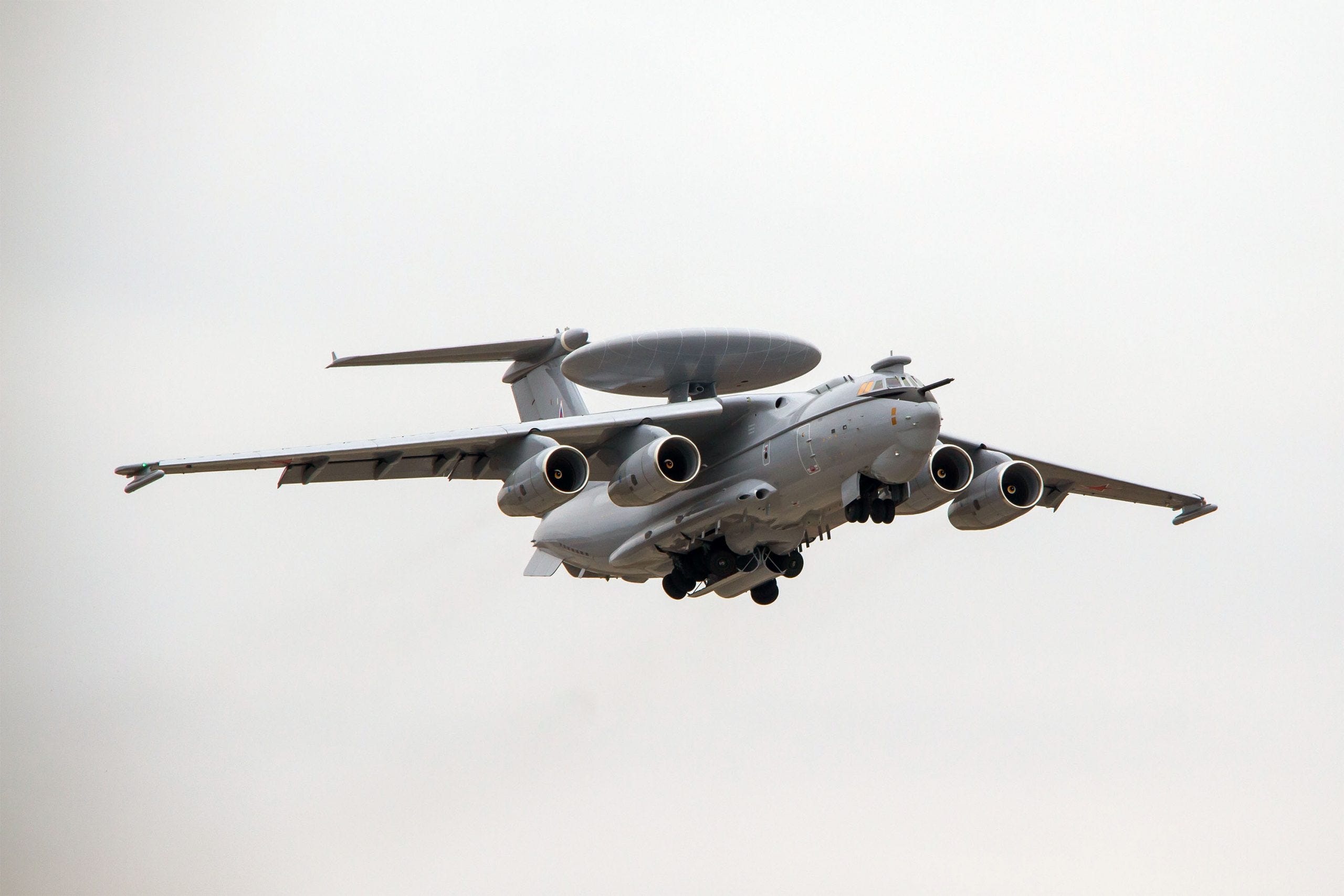
Russia went to war in February 2022 with a functionally negligible fleet of of mostly outdated Soviet-built airborne early warning and control (AEW&C) aircraft, a dynamic that first profoundly limited the effectiveness of the Russian Air Force’s large fleet of combat aircraft in so-called offensive counter-air operations at the outset of the war and later profoundly limited the effectiveness of both Russian fighter aircraft and Russian ground-based air defences against ever increasing numbers of Ukrainian strike drones and cruise missiles. Wartime losses of A-50 AEW&C aircraft at the hands of Ukraine have not improved Russia’s position vis-a-vis Ukraine’s ever-evolving, in both quantitative and qualitative terms, long-range strike capabilities.

The Russian Air Force was supposed to eventually operate a fleet of new-build A-100 AEW&C aircraft, which amount to a like-for-like successor to the Soviet-built A-50 airframes. Reports indicate that the A-100 program is delayed, not least as a result of the disruptions brought about by the Russia-Ukraine War. The program is likely to eventually deliver, but the fact remains that Russia’s geography and the new era of long-range conventional strike capabilities mean that the country requires dozens of AEW&C aircraft. The A-100 is, however, likely far too high-end and expensive a design for Russia to afford in such numbers, at least not without forging investments in other important capability areas.
One option that Russia has is to pursue a two-tier, if not a three-tier, AEW&C aircraft fleet in which the A-100 is complemented by a more modest turboprop-powered design intended to improve airspace awareness in Russia’s vast rear areas. A design in the vein of the Saab Erieye amounts to one possibility. Russia will likely also require a third AEW&C design, which may be crewed or uncrewed, and possibly installed on a rotorcraft instead of a fixed-wing airframe, that can be based at far-flung cities deep in Russia’s interior and activated after, for example, Ukrainian (or NATO) long-range strike drones and cruise missiles are assessed to be en route. In any event, the current state of affairs is simply unsustainable for Russia, and the Kremlin is likely to make concerted efforts to bolster Russia’s rear-area air defences. This will have implications going forward not only for Ukraine, but also for European NATO countries that are working to emulate Ukraine’s mass employment of lower-end strike drones and cruise missiles against Russia. The effectiveness of such armaments can only be expected to wane if and when used against an adversary that benefits from large numbers of flying acquisition radars.