

Memos will briefly refer to a news development, media report, new or historic image/video, map, and the like. You will not receive email notifications for newly posted memos, which can be found via specific tags corresponding to specific sections/newsletters, where you will find longer posts.
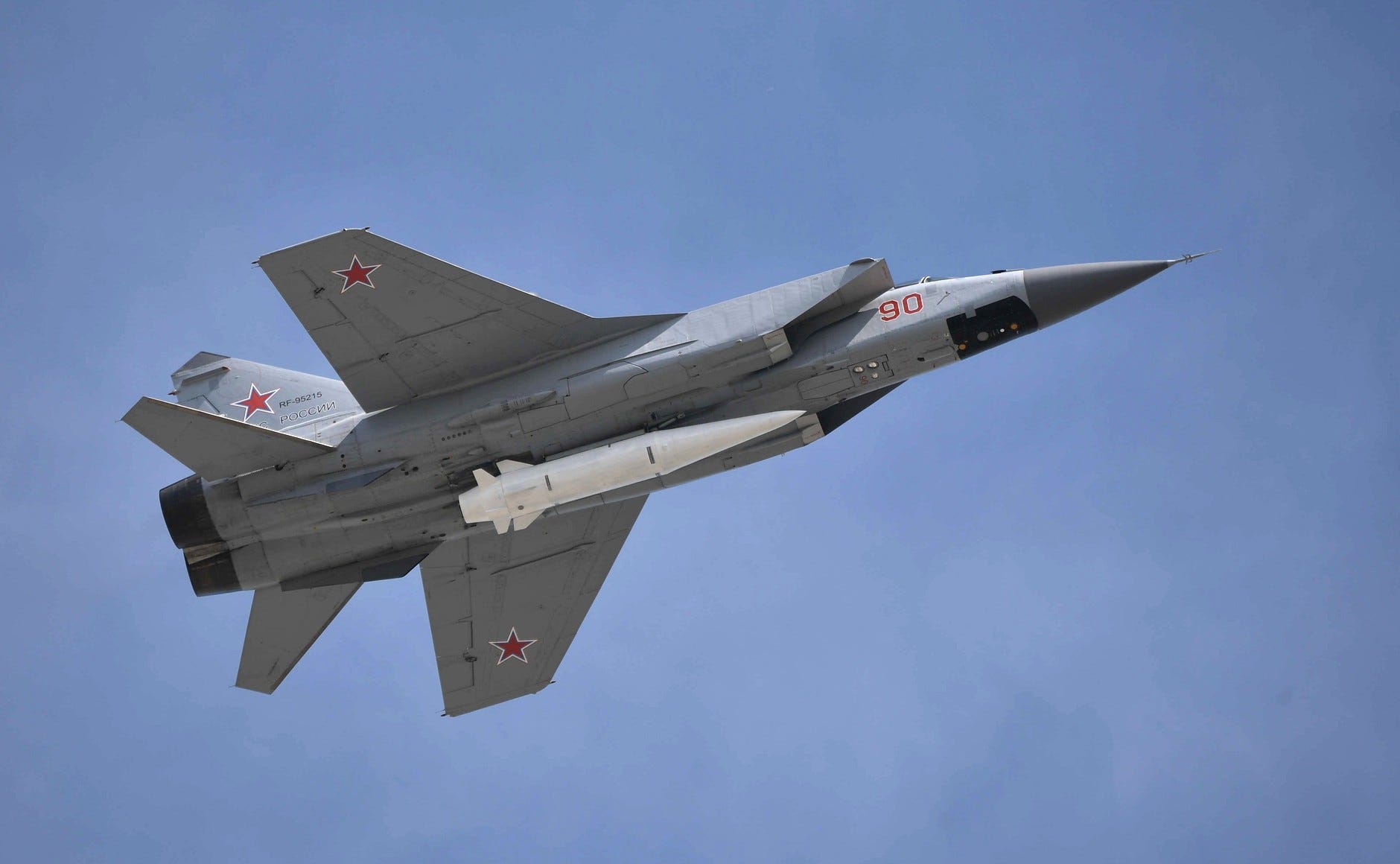
According to Ukrainian officials, Russia is scaling back production of the 9-S-7760 (“Kh-47 Kinzhal”) air-launched ballistic missile on account of the poor observed wartime effectiveness. This development should come as little surprise. If anything, it is surprising that Russia remained committed for so long to such a complex and expensive strike munition that is, to date, exclusively associated with a small fleet of adapted MiG-31K aircraft—employed by the Russian Aerospace Force’s Long Range Aviation, which otherwise employs bomber aircraft. The 9-S-7760 may continue to serve some purpose in the Russian military, especially as a means of delivering nuclear warheads, but remains decidedly ineffective as a means of delivering conventional high-explosive warheads.
For background on the air-launched ballistic missiles including the Russian 9-S-7760 (“Kh-47 Kinzhal”), see:

In principle, an air-launched ballistic missile is inherently well-suited to undertaking simultaneous multi-axis attacks against defended targets, including strikes against highly sectored ballistic missile defence systems such as Patriot—the fire control radars used by Ukraine’s Patriot systems have a field of view of no more than 120°. This, however, requires considerable accuracy and precision, or at least a means of launching such a large number of air-launched ballistic missiles against a defended target and/or a ballistic missile defence system with the aim of overwhelming defences and/or inducing the depletion of ballistic missile defence interceptors and/or damaging, if not destroying, the intended target. If nothing else, being restricted to launch from a small fleet of adapted MiG-31K aircraft dramatically reduced the effectiveness of the 9-S-7760 and made it less competitive relative to ground-launched ballistic missiles in the form of the operational 9M723 Iskander-M and the reportedly under-developed extended-range 9M723-2/“Iskander-1000.” Israel may have made the effective employment of air-launched ballistic missiles look easy in operations against Iran and Qatar, but the approach demands very high accuracy and precision that Russia has not been able to match.

While Russia may not develop and deploy a high-end Israel-like air-launched ballistic missile capability anytime soon, the country still stands to benefit from the flexibility and various operational benefits associated with launching ballistic missiles from altitude, particularly as it concerns operations against NATO. The 9-S-7760 experiment has not delivered in terms of military effects, but Russia may eventually deploy a smaller and shorter-range air-launched ballistic missile, whether something in the vein of the Israeli Rampage or something larger than that, perhaps around 1500 kilograms or so in total weight along the lines of the Soviet Kh-15. More generally, Russia may pursue something in the vein of the Israeli Rampage for use by its fighter and strike aircraft such as the Su-35 and Su-34, which will allow, among other things, Russia to launch large salvos of (much smaller, lighter, and shorter-range) air-launched ballistic missiles to, if nothing else, compensate for the inaccracy of individual missiles in a manner that is simply not possible with the 9-S-7760 and MiG-31K pairing.