
China's AEW&C Fleet And The Prospects For Japan's Employment Of Lower-End Strike Munitions
🇨🇳 🇯🇵 | Memo

Memos will briefly refer to a news development, media report, new or historic image/video, map, and the like. You will not receive email notifications for newly posted memos, which can be found via specific tags corresponding to specific sections/newsletters, where you will find longer posts.
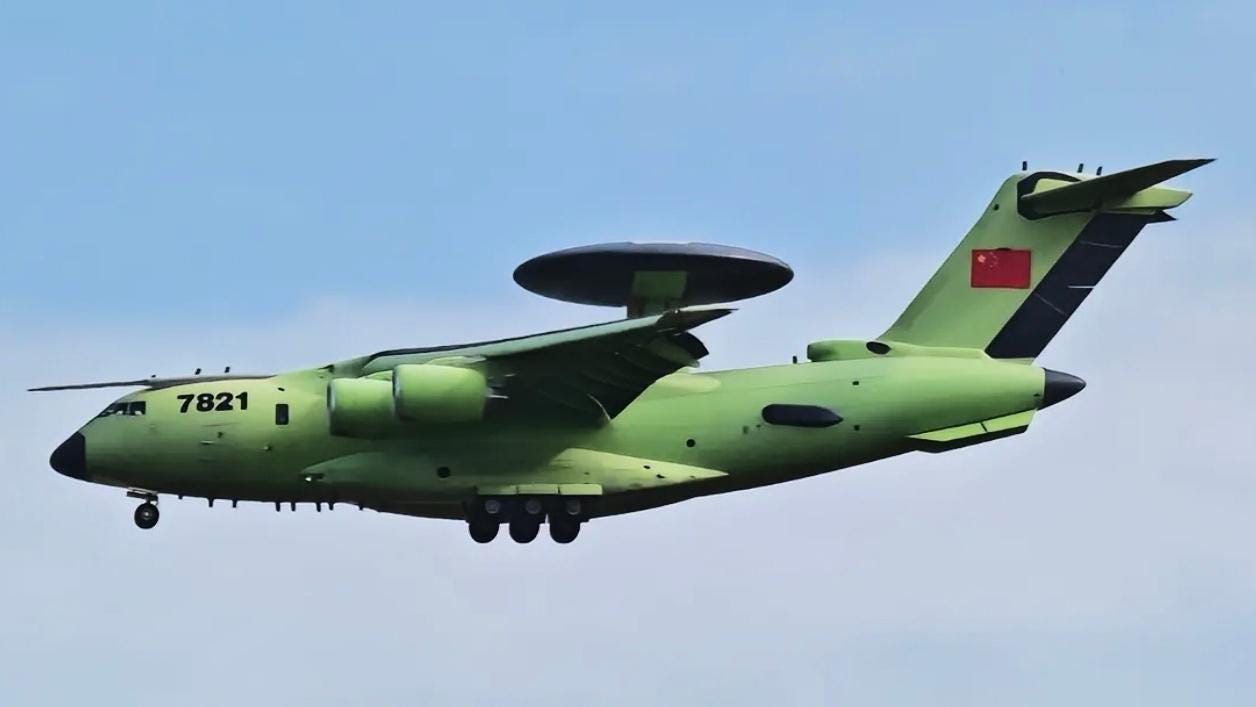
As explained with respect to air defence data from the Russia-Ukraine War, airborne early warning and control (AEW&C) aircraft are particularly well-suited to detecting low-altitude targets and alerting friendly fighter aircraft and ground-based air defences to the presence of aerial targets that they may otherwise not detect or detect at a much later time.

As explained with respect to China, Russia and Ukraine operate very few AEW&C aircraft, whereas China operates more than sixty AEW&C aircraft and continues to build more of newer, more sophisticated designs. As a result, the prospects for the effective employment of large formations of American and/or Taiwanese propeller-driven strike drones in the vein of the Shahed-136, or even low-cost and low payload-range cruise missiles are, all things considered, quite poor.

Japan encounters much the same dynamic when it comes to the potential employment of lower-end strike munitions in large numbers against China as part of its so-called “counterstrike capabilities.” This does not necessarily mean that Japan should forgo investments in these areas, not least in a context in which industrial capacity for higher-end strike munitions is limited, which results in long lead times for production capacity and lengthy delivery timeframes. Lower-end strike munitions have their place, not least as a means of inducing the expenditure of China’s higher-end air defence interceptor stocks and, in so doing, improving the prospects for the effective employment of Japan’s more modest arsenal of higher-end strike munitions. In any event, Tokyo would do well not to simplistically read into the observed “lessons” from the Russia-Ukraine War in this area, if only on account of the tremendous variance in the quality and quantity of AEW&C aircraft available to Russia and Ukraine, on the one hand, and to China, on the other.