

Minimal comment-themed posts are used to introduce data points for use in other posts going forward. Posts of this theme will typically feature minimal analysis and commentary.
Japan’s Sakishima Islands, which refer to a subset of the larger grouping of the Ryukyu Islands Chain, constitute prime “real estate” in the Western Pacific. These Japanese islands are home to expanding Japanese military garrisons, and Tokyo is working on plans to evacuate the 100,000 or so civilians who reside in the Sakishima Islands during a crisis before these far-flung outposts of Japanese military power become war zones.
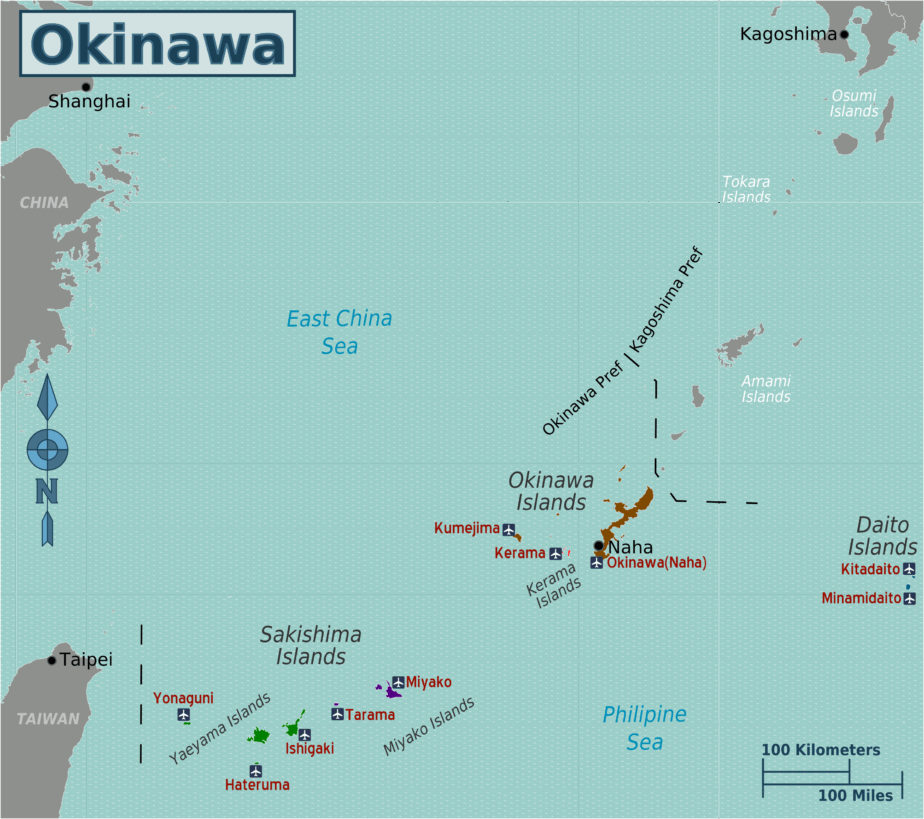

As explained with respect to China’s possible activation of the Sea of Japan threat vector, geography plays a key and often underappreciated role in the fast-evolving China-Japan and China-United States military balance. Technological change is, in effect, making the far-flung Sakishima Islands “increasingly proximate” to China.

The Sakishima Islands are just ~400-550 kilometers from mainland China, 270-510 kilometers from the southern tip of Okinawa island, and ~850-1050 kilometers from the southern tip of Kyushu. Military facilities and militarily relevant infrastructure on the far-flung Sakishima Islands are increasingly exposed to Chinese attack. These small islands, the largest of which is Miyako Island, are not and will never be garrisoned by a fairly dense array of air defence and ballistic missile defence capabilities in the manner of Kadena airbase and other military facilities on Okinawa Island.
An orthodromic distance of just ~400-550 kilometers from mainland China places the Sakishima Islands within range of a wide range of existing Chinese strike capabilities, including stand-off munitions launched from Chinese combat aircraft. It also places the Sakishima Islands within range of a diverse array of “new” strike capabilities, whether propeller-driven fixed-wing strike drones in the vein of the Iranian Shahed-136, low-cost cruise missiles, powered guided glide bombs, and even armed uncrewed surface vessels (USVs).

The isolated Japanese military outposts in the Sakishima Islands are likely to be subject to intense and regular bombardment both at the outset and over the course of a major war. Chinese and Japanese military planners, as well as their American counterparts, are likely to recognize how important it is for Japan to occupy this real estate, which offers land on which to position a wide range of both lower-end and higher-end sensors that can be used to detect Chinese aircraft, surface ships, and even submarines. While the military value of the Sakishima Islands is not in question, the fact remains that these far-flung outposts of Japanese military power are exceptionally and increasingly vulnerable to Chinese strike capabilities.