
Japan Plans To Reorient Some Of Its "Aegis Destroyers" Away From BMD, But BMD Is Also Required For Fleet Operations
🇨🇳 🇯🇵 🇺🇸 | Memo

Memos will briefly refer to a news development, media report, new or historic image/video, map, and the like. You will not receive email notifications for newly posted memos, which can be found via specific tags corresponding to specific sections/newsletters, where you will find longer posts.
Note: Part of the following text was originally posted on my 𝕏/Twitter account. The original text has been expanded upon and edited for grammar and style in this post. Link
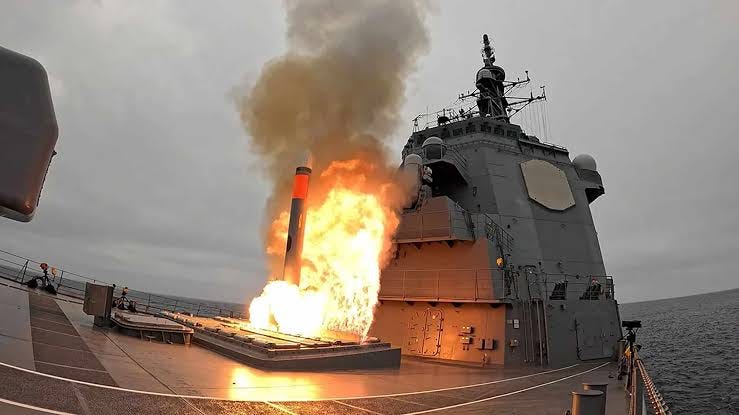
Japan is developing an ostensibly sovereign long-range conventional strike capability set. This includes, among other things, the procurement of ship-launched American-built Tomahawk land-attack cruise missiles.

One of the challenges that Tokyo faces is rooted in how the Japan Maritime Self-Defense Force (JMSDF) is, all things considered, poorly positioned to respond to the growing threat posed by China’s new anti-ship munitions, which are emblematic of the country’s fast-evolving maritime strike capabilities. This is, in large part, a reflection of decades of Japanese choices in the area of fleet design, which resulted in a JMSDF surface fleet that is optimally configured to complement the United States Navy in a manner that results in American warships being primarily responsible for long-range air defence, ballistic missile defence, and long-range conventional strike capabilities.

The JMSDF ships that will carry and launch Tomahawk land-attack cruise missiles from their vertical launch system (VLS) cells are the same eight operational AN/SPY-1 radar-equipped “Aegis destroyers” that have VLS cells loaded with ballistic missile defence interceptors in the form of RIM-161/SM-3 missiles. These happen to be the same ships the JMSDF also requires to provide long-range fleet air defence—the rest of the Japanese surface fleet, including Asahi-class and Akizuki-class destroyers, are impressive in many respects, but are only equipped with short-range and medium-range surface-to-air missiles and, more to the point, much fewer VLS cells. As a result, the introduction of ship-launched Tomahawk cruise missiles in the JMSDF’s arsenal will have the effect of reducing the number of VLS cells that can be loaded with BMD interceptors and/or long-range surface-to-air missiles.
Japan’s eight operational “Aegis destroyers” will be complemented by two under-construction ASEV destroyers in the near future. Japan is likely to require having at least two or three of these ships at sea at any given time to extend BMD coverage across the sprawling Japanese archipelago, a task that requires midcourse BMD interceptors in the vein of the RIM-161/SM-3 for which there currently exists no land-based analogue. As a result, the Tomahawk cruise missiles Japan is deploying to constitute a so-called “counterstrike” capability are competing with BMD interceptors for finite at-sea VLS capacity.
Compounding matters, reports indicate that Japan plans to reorient some of its existing “Aegis destroyers” toward other duties, namely fleet air defence and long-range conventional strike, once the two under-construction ASEV destroyers become operational. The fundamental problem that Japan faces here is that China’s maritime strike capabilities are increasingly centered on ballistic missile-type systems, which makes seaborne BMD a key part of Japanese fleet operations that the JMSDF will have to undertake irrespective of whether the two under-construction ASEV destroyers take on much of the burden of extending BMD coverage across the sprawling Japanese archipelago. Granted, the midcourse RIM-161/SM-3 interceptor is not optimized against the bulk of China’s ballistic-type anti-ship missiles, but Tomahawk cruise missiles will similarly compete for VLS cells with surface-to-air missiles that are suitable against China’s new crop of anti-ship munitions, such as the American-built RIM-174/SM-6 that Japan is procuring.
