
Report Indicates That China Has Launched A New Nuclear-Powered Attack Submarine Design
🇨🇳 | News Analysis

News analysis-themed posts typically focus on recent developments. These posts tend to be much shorter and less detailed than analysis-themed posts.
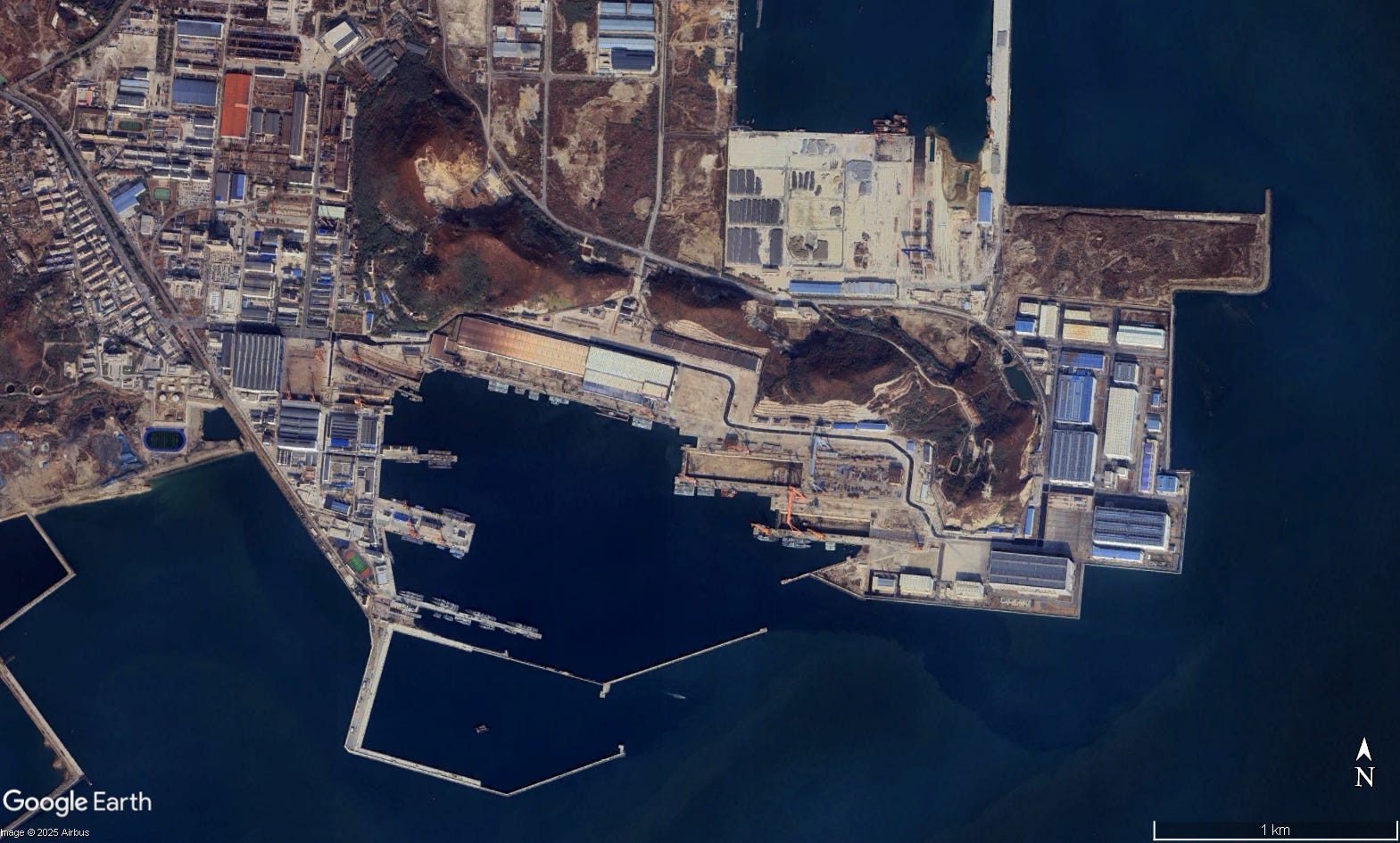
According to military media outlet Naval News, the nuclear-powered submarine that China recently launched at the Bohai Shipyard near Huludao along the Bohai Sea is not yet another Type 093B-class (U.S. ONI: Shang-class) nuclear-powered attack submarine (SSN) but the first completed hull of the long-anticipated next-generation Type 095-class SSN. Much rests on the maturity and competitiveness of China’s Type 095-class SSN design, which may become a major inflection point in the evolution of the People’s Liberation Army Navy (PLAN) and herald a very different era of naval and undersea warfare dynamics in the 2030s and beyond.


Supposing that this claim is accurate, it is analytically productive to think about some of the many uncertainties concerning the future of the Chinese submarine fleet. In the absence of information, observers tend to speculate, but serious analysts identify important areas of uncertainty and raise questions to be answered as new information is uncovered and rendered available. The following questions and the underlying analytical issues are worth considering as additional information becomes available on the new Chinese Type 095-class SSN.
How many Type 095-class SSNs—and other SSNs more generally—does China plan to build and deploy?
Will an expanded SSN fleet come at the cost of a smaller diesel-electric submarine fleet (SSK)? Many older SSKs will need replacing over the coming five to ten years, including both Russian-built Kilo-class (Project 636) SSKs and Chinese-built Type 039 (U.S. ONI: Song-class) SSKs.
Where does the reported Type 041-class (U.S. ONI: Zhou-class) submarine fit into Chinese fleet planning? The Type 041—which is notably not built at the now-expanded shipyard near Huludao along the Bohai Sea in the manner of the Type 095-class SSN and all previous Chinese nuclear-powered submarines—reportedly includes a small nuclear reactor to extend the range-endurance of the submarine. It bears emphasis that the Type 041-class is far too small to substitute for the likes of the Type 095-class SSN and is likely to either supplant or complement SSKs in the PLAN.
Will Chinese shipyards continue to build standard SSKs, including the latest Type 039C-class (U.S. ONI: Yuan-class mod), for the PLAN—as opposed to export customers? If so, will there be a new Chinese SSK design? Other countries, especially South Korea, are expanding the envelope of what an advanced SSK can offer. The appeal of larger, more complex, and more expensive SSKs for the PLAN may or may not be affected by the introduction of not just the recently launched new Type 095-class SSN but also the new Type 041-class.
In the 2010s, the PLAN was rumoured to have a requirement for an SSK design optimized for operations in shallow littoral waters, which the widely deployed Type 039A-class (US ONI: Yuan-class) and the succeeding Type 039C-class are not. There have, to date, been no indications of developments in this area, with the caveat that some large uncrewed underwater vehicle designs—uncrewed/unmanned submarines—may be used to at least partially address this capability gap, which the PLAN may or may not care much about as of 2026 and going forward.
It is possible to raise additional questions that will need answering.
How many reportedly forthcoming Type 096-class ICBM-equipped nuclear-powered ballistic missile submarines (SSBNs) does China plan to build and deploy? What will Type 096-class SSBN production and deployment mean for the existing Type 094-class (U.S. ONI: Jin-class) SSBNs, which reportedly leave much to be desired? Will the Type 094-class SSBN be repurposed for use as conventionally-armed strike munitions launchers in the vein of a subset of American Ohio-class SSBNs?
Supposing that the new Type 095-class SSN is optimized for use as an attack submarine—optimized for use against enemy ships, will China develop and deploy a follow-up design in the vein of the stretched/larger American Virginia-class Block V submarines, which can be equipped with a significantly larger number of vertically-launched terrestrial strike and/or maritime strike munitions?
Will China emulate the Soviet-Russian concept of a missile-centric and maritime strike-optimized nuclear-powered submarine design in the vein of the Project 949 (U.S. ONI: Oscar-class) submarines? It bears emphasis that the recently unveiled Chinese ship- or submarine-launched YJ-17, YJ-19, and YJ-20 long-range anti-ship missiles are all indicative of the direction of travel in this key capability area.


As indicated earlier, observers tend to speculate in the absence of information, but serious analysts try to identify important areas of uncertainty and raise questions to be answered as new information is uncovered and rendered available. Suffice to say, much is uncertain about China’s new Type 095-class SSN in the public domain. There are, more generally, a great many areas of analytical uncertainty of both a qualitative and quantitative nature concerning the future of China’s submarine fleet and undersea warfare capabilities. The long-expected launch of a new Chinese SSN design at the much-expanded—to what end, one must ask—Bohai Shipyard amounts to an important development, but the proverbial analytical glass is nowhere near being even half full.
The following post from October 2025 broached the potential for a Chinese naval base in the general vicinity of the southern coast of Africa, which will help facilitate a hypothetical much-expanded Chinese SSN fleet operate in the Atlantic Ocean, including off the eastern coastline of North America. Suffice to say, no such Chinese naval base currently exists, and the following post highlighted the implications of endemic political instability across much of Sub-Saharan Africa for the PLAN.
