

Memos will briefly refer to a news development, media report, new or historic image/video, map, and the like. You will not receive email notifications for newly posted memos, which can be found via specific tags corresponding to specific sections/newsletters, where you will find longer posts.
The state of American and allied ballistic missile defence (BMD) interceptor stocks is driving a lot of commotion as of late following the reported mass expenditure of BMD interceptors on the part of the United States, Israel, and the Gulf Arab states amid the as-yet unresolved American and Israeli War against Iran and the regional externalities thereof. The proverbial writing was on the wall at the outset of the June 2025 Iran-Israel War, a significant proximate cause of which was the in situ American BMD backstop to Israel’s BMD capabilities, which was first established in late 2023 under the Biden administration and retained under the second Trump administration. The writing was on the wall over the course of summer 2025, when media reports indicated a significant expenditure of MIM-401 Talon (used with the THAAD system) and RIM-161/SM-3 BMD interceptors. The writing was also on the wall in late December 2025, when Israeli Prime Minister Benjamin Netanyahu reportedly visited the White House to make the case for subjecting Iran’s nuclear facilities and missile industries to another round of bombardment.
The timeline matters because anyone in Beijing could also have read the writing on the wall in these timeframes. And yet, there exist, so far, no public indications that China is pursuing a “sprint toward parity” with the aim of taking maximum advantage of the current and, at the very least, near-term state of American (and some allied, albeit less so in East Asia) BMD interceptor stocks by significantly expanding China’s ballistic missile arsenal and associated production capacity.
There was a time around 2010 when one would occasionally hear the phrase “sprint to parity” with respect to the possibility that China may, at some point in the future, rapidly build up its nuclear arsenal amid the arms control caps and discussions about the further reduction of the so-called “strategic” nuclear arsenals of Russia and the United States. China, the thinking in some circles went, would benefit from further bilateral Russia-U.S. arms control measures given how this would decrease what it would take to build up a nuclear arsenal comparable in size to that of Russia and the United States. Some fifteen years later, the entire debate can be reflected upon with considerable amusement. The trajectory of Russia-United States arms control fundamentally changed from 2014 onward, and China still undertook what approximates a sprint to parity in the nuclear realm that became public knowledge from 2020 onward.
As things stand, public estimates indicate that American inventories of PAC-3 CRI and PAC-3 MSE interceptors, which are optimized for BMD unlike the preceding PAC-2 design, have been substantially exhausted, with perhaps fewer than 850 such missiles remaining in the American arsenal.

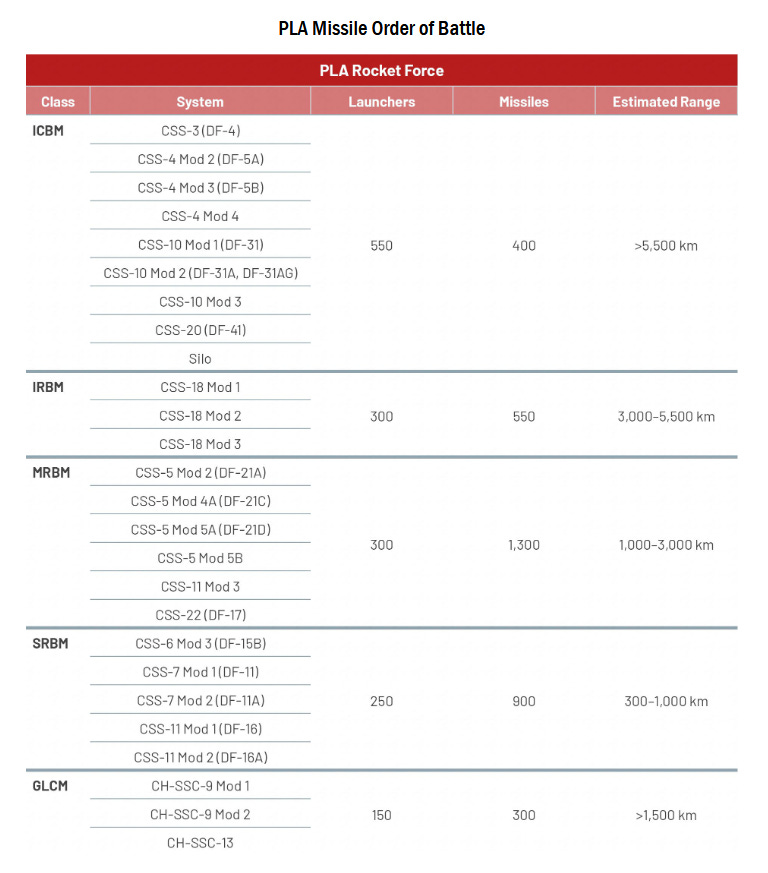
Given such figures, which do not amount to much when it comes to assigning PAC-3 interceptors to multiple Patriot batteries/firing units, there would not be much to a Chinese “sprint toward parity” in this area unless China was going to begin the race with zero conventionally-armed ballistic missiles, which it is not. Good data on China’s (ground-launched) conventionally-armed ballistic missiles, which are (primarily) operated by the People’s Liberation Army Rocket Force (PLARF), is hard to come by. The “best” source is, by default, the annual American so-called China Military Power Report (CMPR), the most recent edition of which was released in December 2025. According to the 2025 CMPR, the PLARF deployed a total of 550 DF-26 ballistic missiles, which outclass the Patriot system (i.e., MIM-401 interceptors for THAAD and RIM-161/SM-3 naval BMD interceptors are more relevant here), 1300 DF-21 and DF-16 ballistic missiles, as well as DF-17 “hypersonic” boost-glide vehicles (BGVs), and 900 shorter-range DF-16 variant as well as DF-15 and DF-11 ballistic missiles, making for a total of 2750 conventionally-armed PLARF-operated ballistic missiles of all types.
The CMPR data is decidedly imperfect. The DF-11, for example, appears to be held in reserve for wartime use, and is ultimately restricted to use against Taiwan in the Western Pacific context. The DF-21 is similarly thought to be on the way out and, at best, heading into reserve status, as it is invariably going to be the case for any missile equipped with a solid-propellant rocket motor that has a limited service life absent expensive life extension efforts. Furthermore, other parts of the PLA also operate ground-launched, air-launched, and ship/submarine-launched conventionally armed ballistic missiles that are, for reasons that remain frankly inexplicable unless accounted for by mere inertia, not included in any CMPR.
The above and other caveats notwithstanding, the 2025 CMPR offers an estimate of 2750 ballistic missiles of all types, over half of which fall within the engagement parameters of the Patriot system when launched against targets near their maximum range. Granted, South Korean, Japanese, and Taiwanese Patriot interceptor stocks were unaffected by the conflict in the Middle East, so the United States does not need to attempt to intercept every single Chinese ballistic missile by itself, not least when a large chunk of these ballistic missiles, including all of the DF-11 and, in my estimation, quite a few of the longer-range designs (for reasons that are beyond the scope of this post), are going to be exclusively launched against Taiwan, which possesses a deep arsenal of BMD interceptors of both American and Taiwanese manufacture. Going by the recent widely invoked CSIS estimate, the United States should have well over a thousand PAC-3 CRI/PAC-3 MSI, MIM-401, and RIM-161/SM-3 BMD interceptors at its immediate disposal. Even if one were to assume an—on average—2:1 allocation of BMD interceptors to inbound ballistic missiles, that is over 500 exclusively American interceptions, which is hardly trivial given the large number of BMD interceptors possessed by American allies in East Asia.
As things stand, public estimates suggest that China exceeds “parity” when it comes to the ratio of Chinese ballistic missiles to American BMD interceptors, although the situation becomes much more complicated when Taiwanese and Japanese, let alone South Korean, BMD interceptor stocks are taken into account. Hence, what one should actually be thinking about is less a Chinese “sprint toward parity” dynamic than a potential Chinese sprint that is intended to fundamentally break away from the United States and, by association, countries that rely on imports of American-built BMD interceptors, for the foreseeable future. For this to happen, China will need to at least make full use of its existing ballistic missile production infrastructure and expand its production capacity over the coming years (returning to the timelines, the proverbial writing has been on the wall since late June 2025, so China may already be working in this direction). Another non-exclusive approach requires China to take a very different path to significantly expanding its ballistic missile arsenal in a manner which can make it look more like the Iranian ballistic missile arsenal and/or the forthcoming American ballistic missile arsenal.
In previous writings, I have explained that the PLARF has long focused on “door-breaking” strike capabilities that will have to be adeptly used against high-value targets so as to create openings for other PLA service branches to bring their own (non-PLARF) strike munitions to bear. In other words, the PLARF’s arsenal may have expanded over the past decade, but there is a highly discernible emphasis on quality over quantity. In the current environment, a more Iran-like approach, which places much greater emphasis on quantity over quality, partially as a result of necessity and partially as a deliberate gambit, one that has paid off quite well in recent months, may be more appealing to China, especially if it assesses that, in broad strokes, emulating the Iranian approach makes for an optimal resource allocation by facilitating cost imposition and virtual attrition upon the United States.
What I have in mind is something in the vein of the solid-propellant Iranian Kheibar Shekan design, which offers a rather desirable balance of payload and range and seemingly good enough accuracy—a ballistic missile with a ~500-kilogram-class warhead, a maximum range of over 1000 kilometers (sufficient to target Kyushu and the northwestern half of Luzon), and seemingly sufficient projected accuracy to warrant the expenditure of one or more BMD interceptors. Perhaps Chinese designers will take a look at the Kheibar Shekan and determine that they can not only do better, which they obviously can, but also conduct trade studies and operations research to provide evidence in support of the view that China may be best off pursuing quality over quantity, even if the optimization point shifts more toward the Iranian arsenal than the PLARF’s existing arsenal This may well lead China toward a difficult direction in which the PLARF ends up, at least in part, emulating the forthcoming American approach to ballistic missile design.


As I explained in two recent posts, there is no magic in military technology and the United States is currently pursuing a series of new low(er)-cost and low payload-range strike munitions primarily by accepting the use of very small and light warheads so as to significantly reduce the cost and complexity of a design. I am referring to subsonic cruise missiles as well as ballistic missiles (and related) that offer a maximum range of 500-1000 kilometers, if not more, while restricted to a warhead that weighs less than 100 kilograms, if not less than 50 kilograms. The Blackbeard is but one example of this.
Another data point to consider concerns the planned future “increments” of the U.S. Army’s new PrSM ballistic, which is notably neither developed by a startup nor explicitly pitched as a low-cost armament. Instead of developing a Chinese Kheibar Shekan—or perhaps alongside it, China may develop a Chinese Blackbeard and/or a Chinese PrSM, which is to say a low(er)-cost ballistic missile that can reach a maximum range of 500-1000 kilometers, if not more, while equipped with, at best, a 50-100 kilogram-class warhead. Such a ballistic missile design will not only be less expensive and more affordable in larger numbers and, all else being equal, easier to produce in large numbers, but will similarly help on the cost imposition and virtual attrition fronts vis-a-vis not just the United States but also Taiwan and Japan, among others, not least following the reported mass depletion of American BMD interceptor stocks as a result of the American and Israeli war against Iran.
Given the above, a notional Chinese “sprint toward parity” in the realm of ballistic missile stocks can take on a very different form than the PLARF simply doing more of the same with a much-enlarged but otherwise quite similar arsenal. It bears emphasis that the notional Chinese missiles I have in mind may not even be deployed by the PLARF, at least not exclusively. The PLA Ground Force (PLAGF), which is the lead PLA service branch in a Taiwan invasion scenario, has returned to the ballistic missile game in full force. The PLA Air Force (PLAAF) already deploys air-launched ballistic missiles (ALBM) and may double down on this path by deploying such ballistic missiles, including low(er) cost designs, in large numbers (a great benefit of ALBMs is that launching a single-use 300 kilometer range ALBM from a reusable aircraft located 500 kilometers from your territory is tantamount to having a 800 kilometer range ballistic missile at a much lower unit cost). The PLA Navy (PLAN) is also deploying ship- and submarine-launched ballistic missiles and, like PLAAF aircraft, also offers major benefits in terms of what amounts to a range extension via a forward launch position as well as greater scope to take advantage of trajectories not available to the PLARF’s ground-launched ballistic missiles.