

Memos will briefly refer to a news development, media report, new or historic image/video, map, and the like. You will not receive email notifications for newly posted memos, which can be found via specific tags corresponding to specific sections/newsletters, where you will find longer posts.
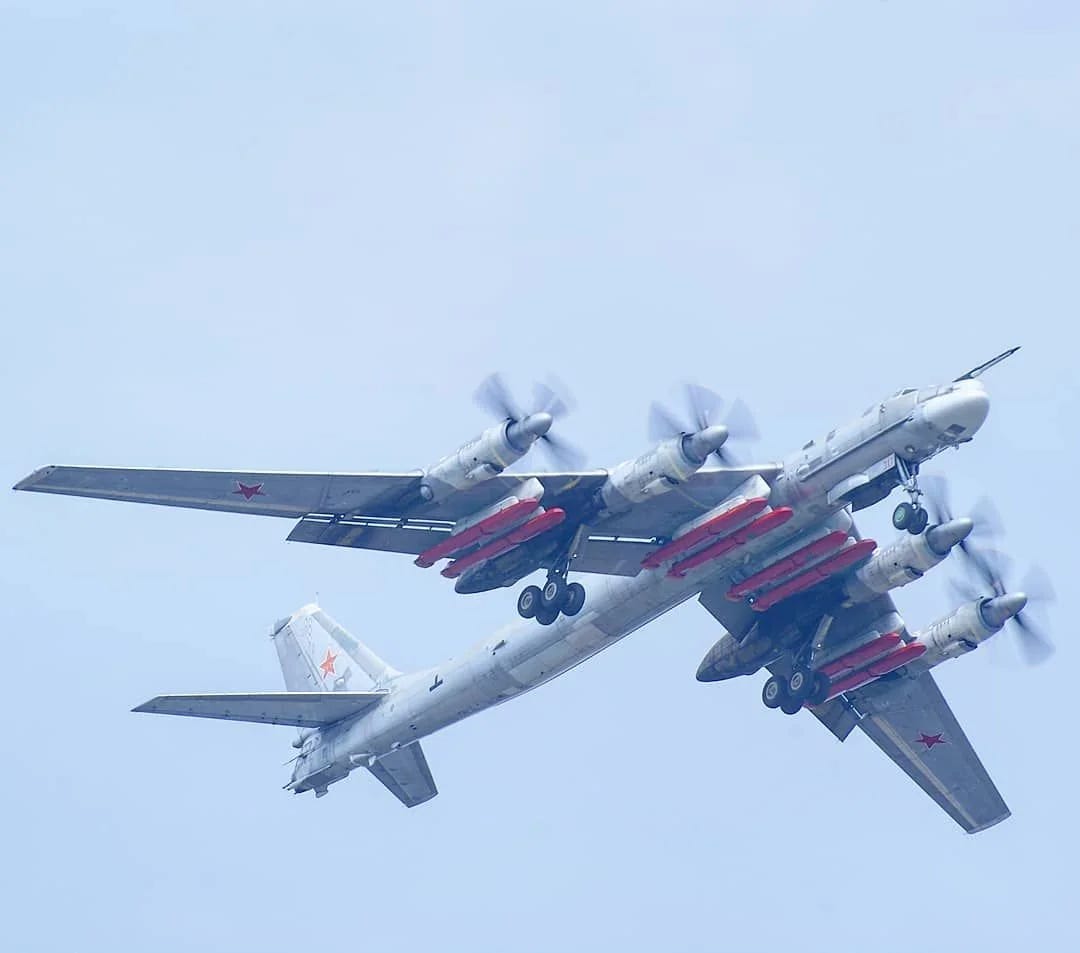
Russia’s heavily taxed fleet of Tu-95 and Tu-160 bombers is regularly employed as launch platforms for subsonic Kh-101 land-attack cruise missiles (Russia’s Tu-22M bombers are, to date, exclusively associated with using very different supersonic Kh-22/Kh-32 cruise missiles, which have proven to be of limited effectiveness). For much of the Russia-Ukraine War, Russia had greater theoretical launch capacity than it had strike munitions available for launch. Sustained stockpiling for periodic launches was the norm. The situation has changed over time, with Russian strike munition stocks now being much larger as a result of the sustained expansion of production capacity, with the important caveat that Ukraine’s air defences have also improved in the interim, such that a greater availability of missiles does not always translate into a higher penetration rate for Russian missiles. Moreover, Russia faces new pressures as a result of attrition inflicted by Ukraine and imputed attrition resulting from sustained use over the course of the Russia-Ukraine War. Russia’s bomber force is fast burning through the remaining flight hours of out-of-production Soviet-built aircraft, not least as a result of operating from very distant airbases, and also suffered heavy attrition during Ukraine’s June 2025 Operation Spiderweb. The Russian Aerospace Forces’ Long Range Aviation, which operates the country’s bomber aircraft, is not, therefore, in a state of bliss. All things considered, it needs more aircraft and, at the same time, it also needs more munitions, so as to make the most of every possible bomber sortie.
Russia is likely to reduce the pressure on its bomber force in several ways, including adapting the ordinarily air-launched subsonic Kh-101 for launch from the ground, employing other non-bomber combat aircraft as launch platforms for cruise missiles (not the Kh-101) and, more speculatively, adapting the in-production Il-76MD-90A heavy military transport aircraft into an ad hoc bomber via the pairing of new mass-produced, low-cost, and low payload-range cruise missiles such as the Banderol and Geran-5 and a palletized air-dropped launch mechanism in a manner similar to the American Rapid Dragon and FAMM-P efforts.

While Russia may or may not come to employ an air-dropped palletized launch mechanism to turn transport aircraft into surrogates for bomber aircraft, the recently introduced Banderol, Geran-5, and the S-71K Kovyor, which all notably make use of low-cost turbojet engines, highlight what is well within the realm of possibility when it comes to Russia’s bomber force. In principle, there is scope, for example, for a Tu-95MS to launch not eight Kh-101 air-launched cruise missiles but a larger quantity of Banderol cruise missiles or a derivative thereof. This will allow Russian bomber aircraft to launch larger salvos per sortie. While Russia’s new cruise missiles are less expensive and better suited to mass production— largely on account of having a significantly lower payload-range than the Kh-101, which notably has excessive payload range for most purposes in the military-geographical context of the Russia-Ukraine War—it bears emphasis that all Russian subsonic cruise missile designs have had decidedly unimpressive penetration rates against Ukraine’s air defences over the course of the war. In such a context, lower-cost cruise missiles are, all things considered, a better value proposition. Even if intercepted by Ukraine’s air defences, it is one thing to lose an expensive Kh-101 in an unsuccessful strike and another matter entirely to lose even multiple lower-cost cruise missiles such as the Banderol and Geran-5 in an unsuccessful strike—provided that launches induce the expenditures of finite quantities of surface-to-air and air-to-air missiles available to Ukraine. As things stand, Russia’s bomber force is poorly positioned to play the long-underway attritional game with Ukraine’s air defences and, by association, with the military-industrial capabilities of the countries arming Ukraine. A low-cost air-launched cruise missile will change that.
More generally, Russia’s approach to operating bombers as launch platforms for air-launched cruise missiles has been exceptionally inefficient in the context of the Russia-Ukraine War in a manner that is not dissimilar to the ill-conceived and much-hyped “Kalibrization” of the Russian Navy.


Ukraine's territory is no more than ~1300 kilometers wide, and Kyiv—the target for so many Russian munitions, including air-launched cruise missiles—is located 200-300 kilometers from the closest sections of the international border. As Ukrainian strike drone and cruise missile attacks on Russian bomber bases expanded in scope and became a more regular occurrence, Russia redeployed the vast majority of its bomber aircraft from their peacetime bases in western Russia to more distant airbases in the form of Olenya, which is located in the Kola Peninsula near the Barents Sea, and Ukrainka, which is located in the Russian Far East. From these distant airbases (from which Russian bomber aircraft have long operated), Russian bombers periodically “forward-deploy” to airbases closer to Ukraine, including the long-standing Engels-2 airbase near Saratov along the Volga River, so as to launch cruise missiles before returning to the safer, more distant airbases.
As with the rather farcical effects of the “Kalibrization” of the Russian Navy in the Black Sea context, the problem that Russia faces has transitioned from having too few strike munitions for too many launch platforms to increasingly having too many strike munitions for too few launch platforms or, with respect to Russian bomber aircraft, for too few bomber sorties. A low-cost and low payload-range air-launched cruise missile in the vein of the Banderol and Geran-5 can help remove the strike munition bottleneck on Russian bomber operations and increase the efficiency of the Russian bomber force by launching a larger number of munitions per sortie in the context of a war that has taken on an exceedingly attritional nature, not least in the contest between strike munitions and air defence capabilities.
As things stand, there are no public indications that Russia is moving in this direction. The Banderol, for example, is operated by the Russian Army, not the Russian Aerospace Forces, with Kronstadt Orion/Inokhodets fixed-wing uncrewed aircraft and, reportedly, Mi-28 attack helicopters, as its launch platforms (there also appears to exist a ground-launched adaptation of the Banderol). While the S-71K Kovyor is associated with the Russian Aerospace Forces’ non-bomber combat aircraft, the Banderol is not.

As for the Geran-5, the design is more interesting and relevant for the present purposes in terms of its components rather than the airframe itself, which is not optimized for use as an air-launched cruise missile, especially with the likes of Tu-95 and Tu-160 bomber aircraft. Many of the components in the Geran-5, however, amount to ingredients through which Russia take advantage of economies of scale with the aim of developing and deploying a low-cost and low payload-range air-launched cruise missile that is suitable for use with the Tu-95 and Tu-160.
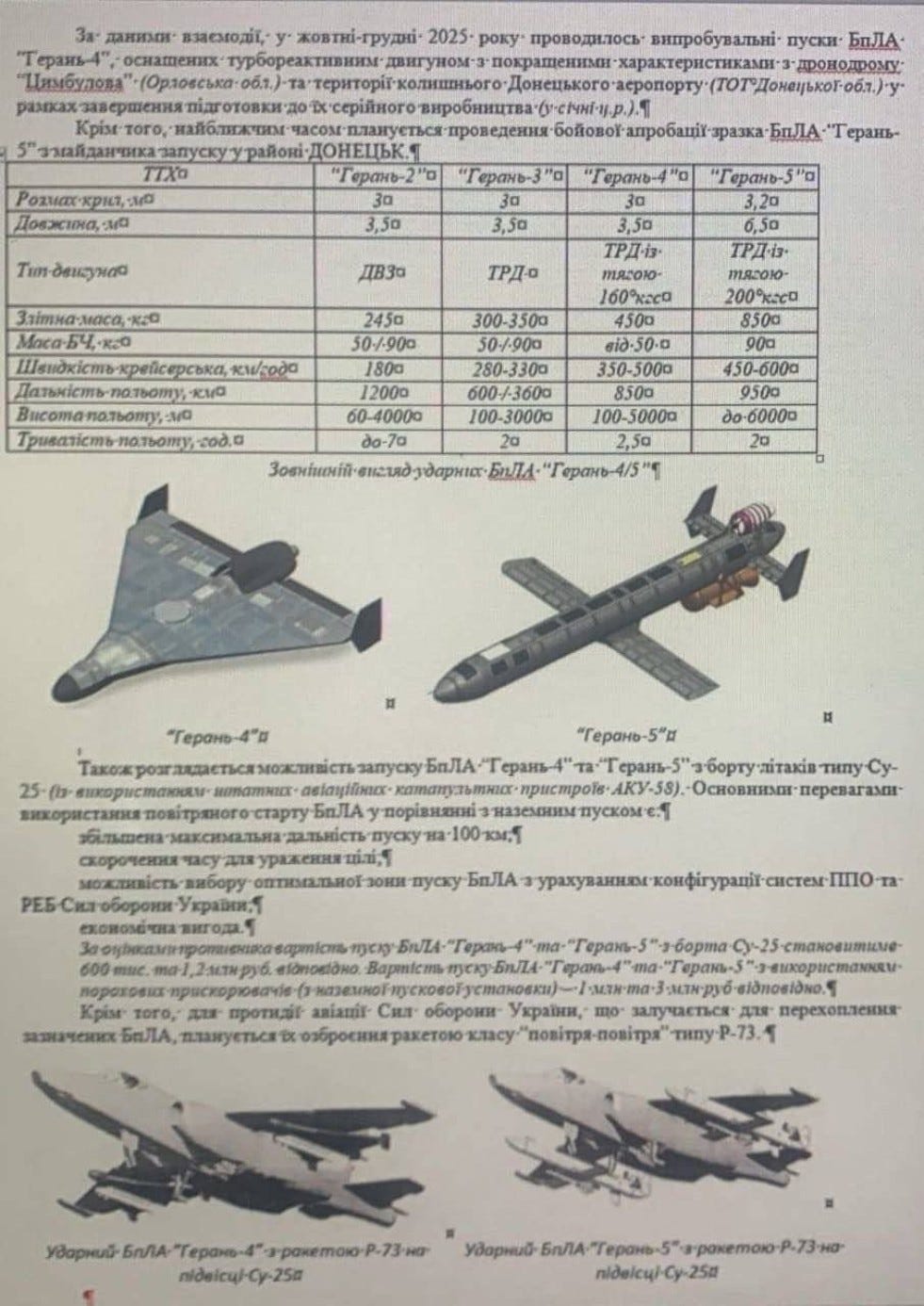
It bears mentioning that leaked documents suggest that Russia is considering integrating both the (very different) Geran-4 and Geran-5 onto non-bomber combat aircraft in the form of Russia’s large but also ineffectively utilized fleet of Su-25 ground attack aircraft. The Geran-4 is also not suitable for use with Tu-95 and Tu-160 bombers and may not even be successfully integrated onto the Su-25, but the above leaked scan of a Russian document nevertheless highlights some of the directions that the Russian military and Russian designers are pursuing. A revamp of Russia’s bomber force via new armaments in the form of a mass-produced, low-cost, and low payload-range air-launched cruise missile is not beyond the realm of possibility.