

Memos will briefly refer to a news development, media report, new or historic image/video, map, and the like. You will not receive email notifications for newly posted memos, which can be found via specific tags corresponding to specific sections/newsletters, where you will find longer posts.
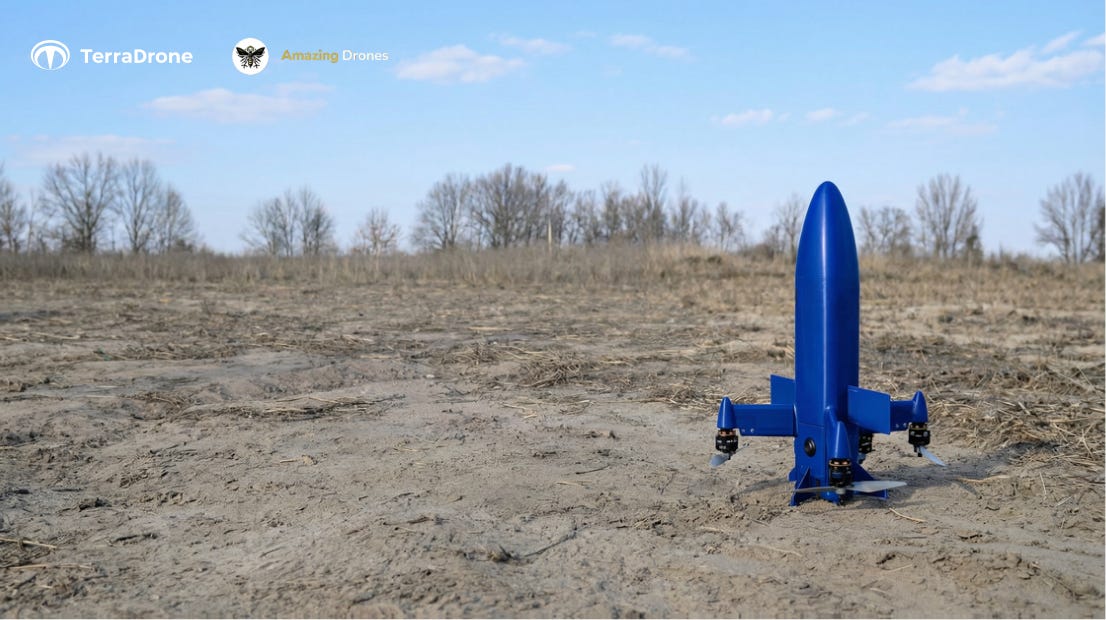
Japan is proactively pursuing the development and deployment of electrically powered interceptor drones of both the fixed-wing and multirotor variety, which function as slower surrogates for rocket-powered surface-to-air missiles optimized for use against various types of uncrewed aircraft against which conventional surface-to-air missiles are either not optimized or, more importantly, cannot be practically employed on account of unfavourable cost-exchange dynamics and woefully inadequate stockpiles. Tokyo is, in other words, learning its lessons from the Russia-Ukraine War as well as the American and Israeli war against Iran and the ongoing externalities thereof across the Middle East.

As of this writing, public sources only indicate that Russia deploys long-range fixed-wing strike drones in the vein of the Shahed-136. North Korea is, however, reportedly interested and has strong incentives to pursue developments in this area, not least with the benefit of reported technological assistance from Russia. China is itself exceptionally well positioned to do the same, and Chinese industry has already developed a series of designs, some of which have been exported, but the People’s Liberation Army (PLA) itself does not appear to deploy such strike drones at this time. This may, however, change on very short notice, and Japan is therefore incentivized to be proactive about these potential and latent—if not already existing—threats, not least in a context in which technological change is only set to make the task of the defender so much worse over the coming years. One driver of this is the ongoing diffusion of low Earth orbit (LEO) satellite communications (LEO SATCOM), the best-known example of which is Starlink, which is commercially available in Japan.

Both China and Russia are working on their own LEO SATCOM constellations, and these countries, as well as North Korea, may come to deploy LEO SATCOM-equipped strike drones in the vein of the Shahed-136 in very large numbers. Without lower-cost and easier-to-manufacture interceptors suitable for use against such slow and kinematically non-complex threats that even the likes of North Korea can afford to build and employ in truly massive numbers, Japan risks burning through its large but nevertheless finite arsenal of high-end surface-to-air missiles in the opening days, if not weeks, of a war, in a manner not dissimilar to the Gulf Arab states in the ongoing war against Iran, or indeed even the United States in that conflict.


While inexpensive long-range but low payload-range strike munitions pose a major challenge to Japan, interceptor drones such as the Terra A1 and Terra A2 offered by a Japanese vendor are also required to secure Japanese military facilities and critical national infrastructure from smaller uncrewed aircraft potentially launched from Japanese territory itself, including by Chinese, North Korean, and Russian external operations personnel. There are thousands of consequential and, as such, lucrative potential industrial targets across Japan. No country can hope to secure all such facilities with anything other than a low-cost interceptor in the vein of an electrically powered fixed-wing or multirotor uncrewed aircraft turned low-cost surface-to-air missile surrogate.