

Memos will briefly refer to a news development, media report, new or historic image/video, map, and the like. You will not receive email notifications for newly posted memos, which can be found via specific tags corresponding to specific sections/newsletters, where you will find longer posts.
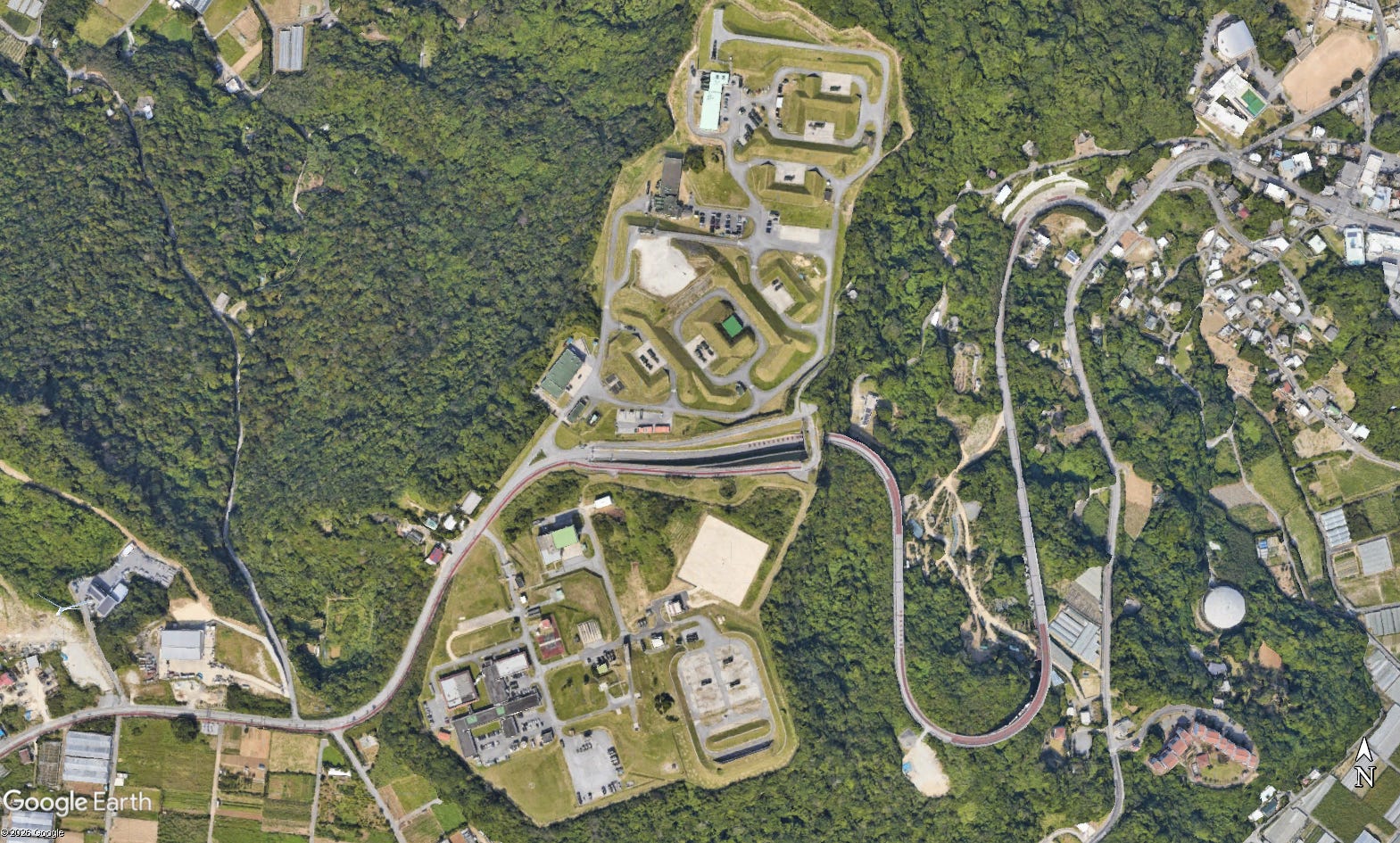
As explained in a recent memo, the American Patriot air defence/ballistic missile defence (BMD) system, which forms a critically important pillar of Japanese capabilities in these areas through the deployment of no fewer than twenty-four Patriot batteries by the Japan Air Self-Defense Force (JASDF), has a major limitation: its existing fire control radars are limited to a wedge-shaped 120° field of view and result in similarly restricted coverage. For a sprawling country with widespread line-of-sight restrictions imposed by natural and anthropogenic terrain, this poses major challenges, not least in a context in which the Chinese strike munitions threat to Japan is increasingly of a multi-axis nature. Nowhere is this dynamic clearer or more consequential than in the Ryukyu Island Chain, including not just Okinawa but the expanding list of smaller islands in which Tokyo is establishing military garrisons.
Radars are often assumed to be inherently omniscient of their surroundings. This is not the case for a variety of reasons, including but not limited to the line-of-sight nature of the electromagnetic radiation emitted by most radars, topographical variation including but not limited to the mountains found across the Japanese archipelago, and, not least, the fact that a single non-rotating radar antenna is limited to a 120° field of view at any given time. The American Patriot system was originally designed for use near the Inner German Border against threats emanating from the east, in a context in which geography did not allow the Soviet Union and Warsaw Pact to launch strike munitions that approached Patriot batteries from the west or south. For a long time, Japan could, for the most part, similarly arrange its Patriot batteries toward certain directions in China and North Korea.
The following map, the author of which is specified in the graphic, offers a useful illustration of Japan’s ground-based air defence coverage with the major caveats that it (A) does not reflect the fact that the mountains found across Japan severely diminish real-world coverage (i.e., the map essentially treats Japan as if it were a flat plain), (B) does not account for the effects of target altitude and thereby depicts what amounts to a flat Earth, (C) does not reflect the fact that individual Japanese Patriot batteries do not offer a 360° field of view/wedge-shaped sector of coverage but a 120° field of view/wedge-shaped sector of coverage. To obtain anything close to 120° coverage around a deployment area, Japan must position multiple Patriot batteries/fire units oriented toward different directions, a dynamic that can be very inefficient given how some of the surface-to-air missiles may be oriented away from inbound threats.
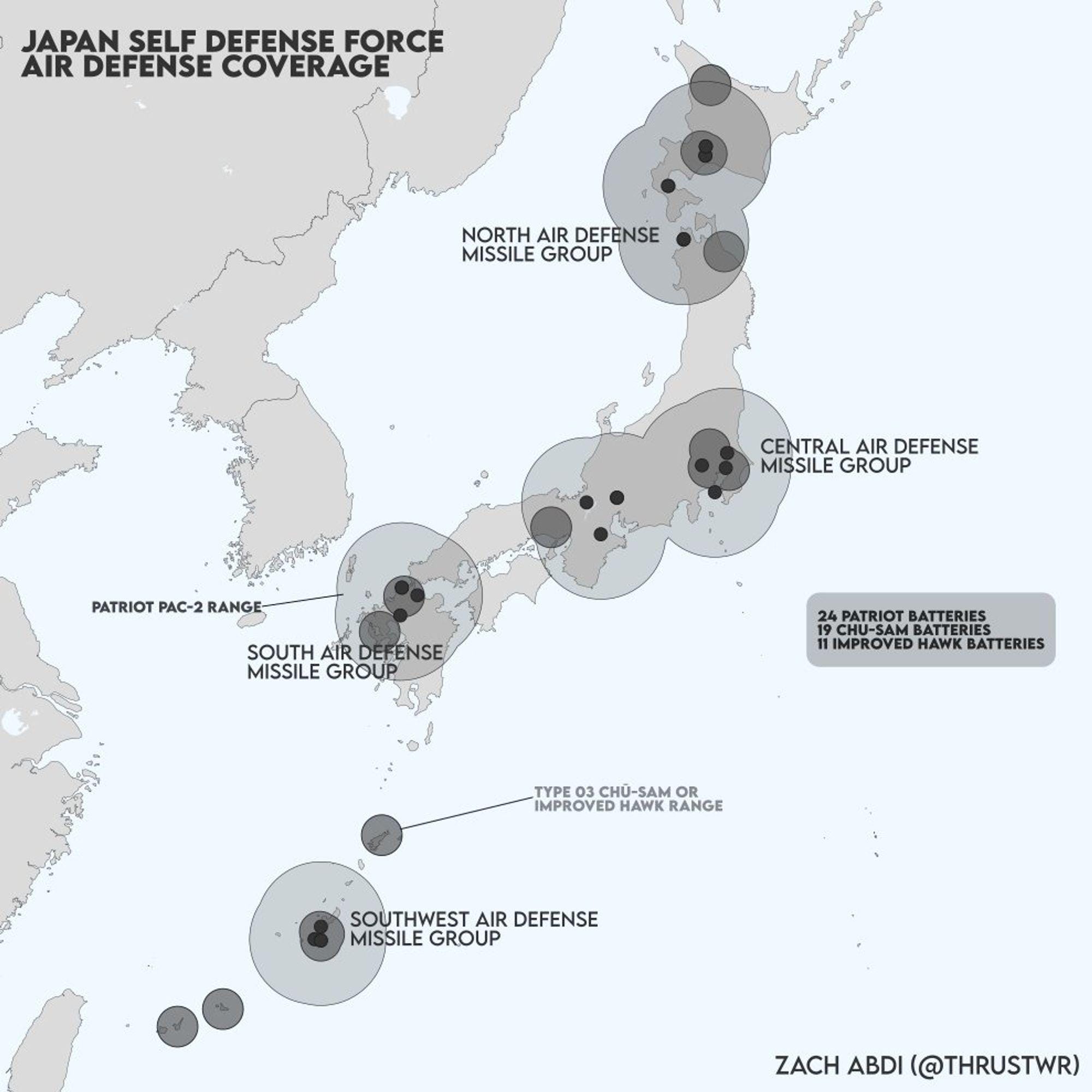
Although Japan encounters this dynamic across the Japanese archipelago, the sectored nature of Patriot coverage is most problematic in the Ryukyu Islands Chain, including but not limited to the island of Okinawa, which is home to both Japanese and American Patriot batteries. In Okinawa and other parts of the Ryukyu Islands Chain, Japan faces the worst of all worlds in a context in which Chinese ground-launched, sea-launched, and air-launched strike munitions can undertake multi-axis attacks. With the advent of boost-glide vehicles (BGVs) such as the DF-17 and China’s ability to make use of hitherto unavailable launch trajectories via sea-launched and air-launched ballistic-type strike munitions, Okinawa and the rest of Japan more generally now encounter what increasingly amounts to a 360° Chinese strike munition threat.


Chinese strike munitions may now approach Okinawa from the east, southeast, and south, and Chinese strike munitions may approach the more distant Tokyo area from the east, southeast, south, and southwest, and may even approach the Tokyo area from the west and northwest should China come to activate the long-dormant Sea of Japan threat vector. Stated differently, the interplay of developments in Chinese military technology and strategic choices made on the part of Beijing will determine whether Japan will face a more or less universal 360° Chinese strike munitions threat.


As difficult as the situation is and is set to become elsewhere in Japan, the proverbial hammer will likely fall hardest in the Ryukyu Islands Chain on account of proximity to China. The situation Japan faces will only become worse if and when China fields low-cost strike munitions in large numbers, in the vein of those deployed by Iran as well as by both Russia and Ukraine, against Japan.


This is the context in which the future of Japan’s Patriot systems and the future of Japan’s air defence and ballistic missile defence capabilities need to be understood.

